Quick Answer: Rocky Mountain National Park requires a timed entry reservation from 9 a.m. to 2 p.m. between May 22 and October 12, 2026, and a separate Timed Entry + Bear Lake Road reservation from 5 a.m. to 6 p.m. through October 18. The reservation is not the entrance fee. Denver to Estes Park is 66 to 71 road miles and 1.5 to 2 hours; Fort Collins is 41 miles but about 75 minutes through the Big Thompson Canyon.
The Reservation System Is the Whole Ballgame
Rocky Mountain National Park does not work like a place you drive to on a whim between Memorial Day and mid-October. Since the Day Use Visitor Access Plan was finalized in 2024, entry during the busy hours runs on timed reservations, and the single most common way a Rocky day goes wrong is a party that booked lodging, booked a vehicle, and never booked the park.
There are two reservations, and they are not interchangeable.
| Reservation | What it covers | Hours it is required (2026) |
|---|---|---|
| Timed Entry | Everything except the Bear Lake Road corridor — Trail Ridge Road, Alpine Visitor Center, Wild Basin, the west side | 9 a.m.–2 p.m., May 22 through Oct 12 |
| Timed Entry + Bear Lake Road | Bear Lake Road corridor — Moraine Park, Sprague Lake, Park & Ride, Glacier Gorge, Bear Lake — plus everywhere else | 5 a.m.–6 p.m., May 22 through Oct 18 |
Three details that decide your day:
- The window is two hours, and it is an entry window. Once you are in, you can stay as long as you want. You cannot arrive late and talk your way through.
- Bear Lake re-entry is not allowed until after 2 p.m. If you enter the corridor on a 7–9 a.m. reservation and drive back out for lunch in Estes, you are not getting back in before two.
- Outside those hours you need no reservation at all. Before 9 a.m. or after 2 p.m. for general entry, the gate is simply open to anyone holding a park pass.
Reservations are released on Recreation.gov in monthly batches at 8 a.m. MDT on the first of the prior month, with a second batch released at 7 p.m. MDT the night before each date. The night-before batch is real and it is worth setting an alarm for, but plan on the monthly release. The reservation itself costs a $2 processing fee.
The Reservation Is Not the Entrance Fee
People conflate these constantly. A timed entry reservation is permission to arrive in a window. An entrance pass is the fee to be in the park at all, required 24 hours a day, including at Lily Lake, Longs Peak, Lumpy Ridge and Wild Basin.
- A one-day private vehicle pass is $30 and covers everyone in the vehicle. Standard passes run $15 to $35 depending on type and length.
- The park is cashless. Entrance stations take card or digital payment only. Cash buyers can use the Rocky Mountain Conservancy stores at the Beaver Meadows, Fall River or Kawuneeche visitor centers.
- Non-U.S. residents 16 and over now pay an additional $100 per person unless they hold an Annual or America the Beautiful pass. If you are hosting international guests, price this in before you plan the day.
- Annual and lifetime passes ordered online take two to four weeks to arrive. Buy at the gate if your trip is sooner.
Both the reservation and the pass are tied to your vehicle, whoever is driving it. When we run a Rocky day, the reservation is made by the client under their own Recreation.gov account, and we tell you which vehicle and which window we are working to.
Three Entrances, and Which One You Actually Want
The park covers 415 square miles with Estes Park as the east gateway and Grand Lake as the west.
- Beaver Meadows (US 36, west of Estes) is the main east entrance and the way to Bear Lake Road. It also has the park headquarters visitor center.
- Fall River (US 34, west of Estes) is the entrance for Trail Ridge Road and Old Fall River Road, and it is frequently the shorter line of the two on a summer morning.
- Grand Lake on the west side is the quiet end. Fewer people, more moose, and the Kawuneeche Valley where the Colorado River is still small enough to step over.
Bear Lake Road: Where Everyone Goes and Where Parking Runs Out
Bear Lake Road is the corridor holding Moraine Park, Sprague Lake, Glacier Gorge and Bear Lake itself, which is the reason it has its own reservation. The lots at Bear Lake and Glacier Gorge fill early — early meaning before seven on a July Saturday, not by mid-morning.
The park's answer is the Park & Ride transit hub partway up the road, with free shuttles running the Bear Lake and Moraine Park routes in season. From Estes Park, a separate Hiker Shuttle runs to Park & Ride, with reservations required. If your plan is a Bear Lake sunrise or an Emerald Lake hike, the realistic version is: be through the gate before the reservation hours start, park at Park & Ride, and take the shuttle up.
The chauffeured version removes the parking problem entirely. We drop at the trailhead and the vehicle leaves. There is no circling, no eight-hour meter running on a space, and no argument about who wakes up at 4 a.m. to claim it.
Trail Ridge Road: Half a Day, Not an Hour
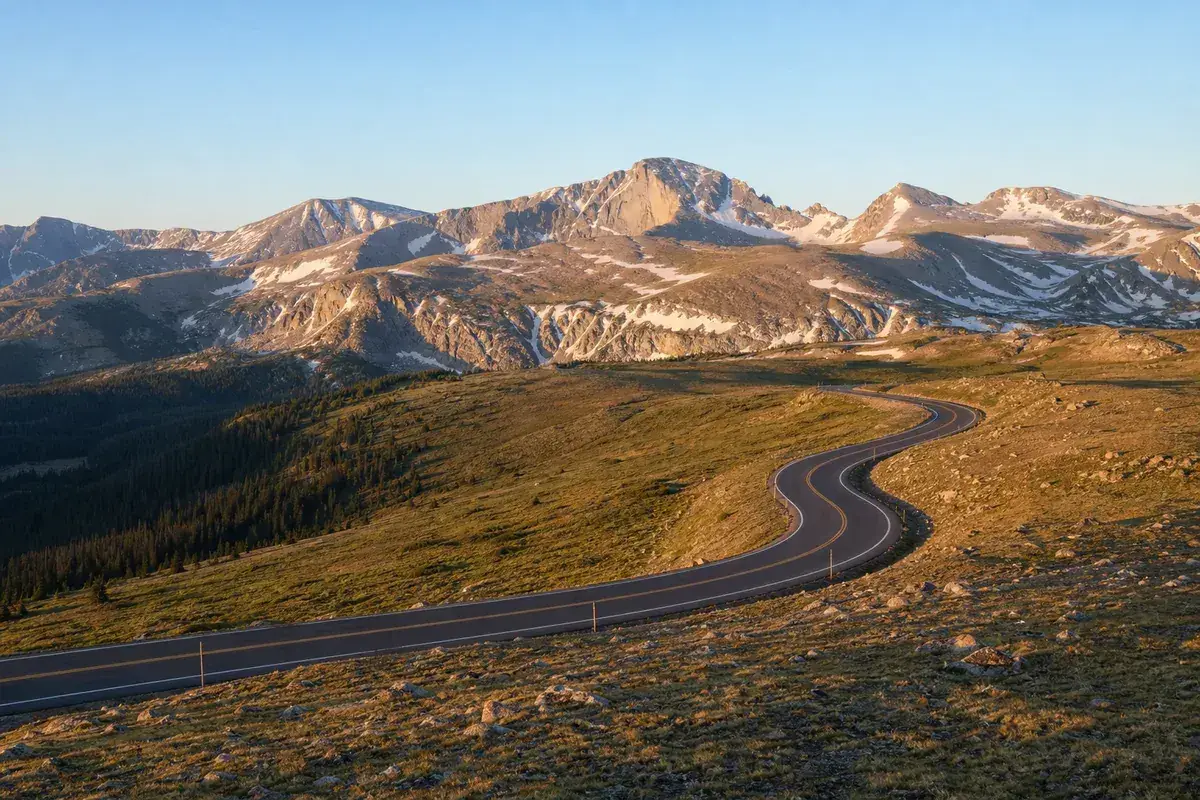
Trail Ridge Road is US 34 across the top of the park — 48 miles between Estes Park and Grand Lake, eleven of them above treeline, topping out at 12,183 feet. It climbs about 4,000 feet from either end, and it is one of Colorado's ten America's Byways.
What people get wrong about it:
- It is a half-day drive, not a scenic detour. Estes to Grand Lake with stops is three to four hours honestly done. Add the return unless you are staying on the west side.
- It is 20 to 30 degrees colder up top than in Estes Park, and windy. Guests in shorts and a t-shirt will last about four minutes at Rock Cut.
- It closes. Roughly mid-October through late May, depending entirely on snow. Milner Pass, where you cross the Continental Divide, sits at 10,758 feet, and the road above it holds drifts long after the plains are dry.
- Altitude is a real factor. Going from Denver at 5,280 feet to 12,183 feet in one morning affects people. Water, a slow pace at the pullouts, and no assumption that everyone in the party is fine.
Getting There from Denver, DEN and the Front Range
| From | Route | Distance | Typical time |
|---|---|---|---|
| Denver | I-25 north to US 36 via Boulder and Lyons | 66 miles | 1.5–2 hours |
| Denver | I-25 north to Hwy 66 through Longmont | 71 miles | 1.5–2 hours |
| Denver | Peak to Peak Scenic Byway via Nederland | 108 miles | 2.5–3 hours |
| Fort Collins | US 34 through the Big Thompson Canyon | 41 miles | About 75 minutes |
| Grand Lake side | I-70 to US 40 via Empire and Granby | 61 miles | 1.5–2 hours |
Denver International Airport is the closest major airport, and there is no public transportation from the airport to the park. The Big Thompson Canyon route from Loveland is open, with construction delays of up to twenty minutes still possible — it is also a two-lane canyon road, which is why 41 miles from Fort Collins takes 75 minutes rather than the 45 people budget for it.
The airport-to-Estes math is the one that catches families. A 10 a.m. landing at DEN, bags, a 75-minute drive and a check-in is not a day that also includes Bear Lake. Plan the park for the next morning and use arrival day for Estes itself.
What Each Season Actually Asks of You
- Summer (June–August). Reservations required for both windows, Trail Ridge fully open, afternoon thunderstorms routine above treeline. Be off the tundra by early afternoon.
- Fall (September–mid October). Elk rut in Moraine Park and Horseshoe Park, aspen turning, and the most competitive reservation slots of the year. Trail Ridge closes at the first serious storm, sometimes for good.
- Winter (November–April). No reservation system, no crowds, and the park is genuinely open. Trail Ridge is closed for the season, and the lower east-side roads including Bear Lake Road are typically kept plowed — check current park road conditions the morning of. Snowshoeing at Bear Lake on a January weekday is the best-value day in the park.
- Spring (May). The awkward month. Trail Ridge is usually still closed, lower trails are mud and rotten snow, and the reservation system starts on May 22.
How We Run a Rocky Day
Park days are hourly work, not point to point, and that is not a billing preference — it is what the day requires. The vehicle stays with you, the plan changes at the second trailhead, and nobody is refreshing an app in a canyon with no signal.
- We work backwards from your entry window. Tell us the reservation you hold and we set the pickup time from it, with the canyon drive and a stop built in, not squeezed.
- Early starts are the point. A 5:30 a.m. departure to be through Fall River before the 9 a.m. window begins is trivial for a chauffeur and miserable for a guest who landed at DEN the night before.
- Trailhead drops, no parking. Bear Lake, Glacier Gorge, Wild Basin — we drop, we stage, we come back to an agreed point and time.
- Vehicles seat up to 12. Larger groups run as a coordinated wave on one timeline with one dispatch contact per vehicle.
- No lift or ramp. Folding chairs and walkers travel fine, and we will tell you honestly what a given trailhead looks like before you book. Our accessibility guide covers the details.
Rates are hourly and depend on vehicle and date. Ask for a free quote with your entry window and we will build the day around it.
Frequently Asked Questions
Do I need a timed entry reservation for Rocky Mountain National Park in 2026?
Yes, during the busy hours. A Timed Entry reservation is required from 9 a.m. to 2 p.m. daily from May 22 through October 12, 2026. A Timed Entry + Bear Lake Road reservation is required to enter the Bear Lake Road corridor from 5 a.m. to 6 p.m. from May 22 through October 18. Outside those hours no reservation is needed, only an entrance pass.
Does a timed entry reservation cover the entrance fee?
No. They are two separate things. The reservation costs a $2 processing fee on Recreation.gov and only sets your arrival window. A valid entrance pass is required 24 hours a day; a one-day private vehicle pass is $30 and covers everyone in the vehicle.
Can my chauffeur get us into the park without a reservation?
No. The reservation applies to the vehicle entering the park, no matter who is driving. Clients make the reservation on their own Recreation.gov account, and we plan the pickup time around the window it gives you. The alternative we use often is entering before 9 a.m., which needs no reservation.
How long does the drive from Denver International Airport to Estes Park take?
Plan on about two hours from DEN, and longer on a summer Friday. There is no public transportation from the airport to the park. From Fort Collins it is 41 miles but roughly 75 minutes, because US 34 through the Big Thompson Canyon is a two-lane canyon road with ongoing construction delays.
Is Trail Ridge Road open year-round?
No. Trail Ridge Road closes from approximately mid-October through late May, depending on snow. It runs 48 miles between Estes Park and Grand Lake, reaches 12,183 feet, and is 20 to 30 degrees colder at the top than in Estes Park. Allow at least half a day for the drive.
Is it worth hiring a car service for a park day instead of driving?
It solves two specific problems: parking at Bear Lake and Glacier Gorge, which fills before 7 a.m. in summer, and the drive itself, which is a canyon road at altitude. Park days run hourly with the vehicle staying with you, so the plan can change at the second trailhead.
Can you accommodate wheelchairs or walkers?
Folding wheelchairs and walkers travel with us without a problem. We do not operate lift or ramp equipped vehicles. Our DEN accessibility guide covers what we can and cannot do, and we will tell you what a specific trailhead looks like before you book.


