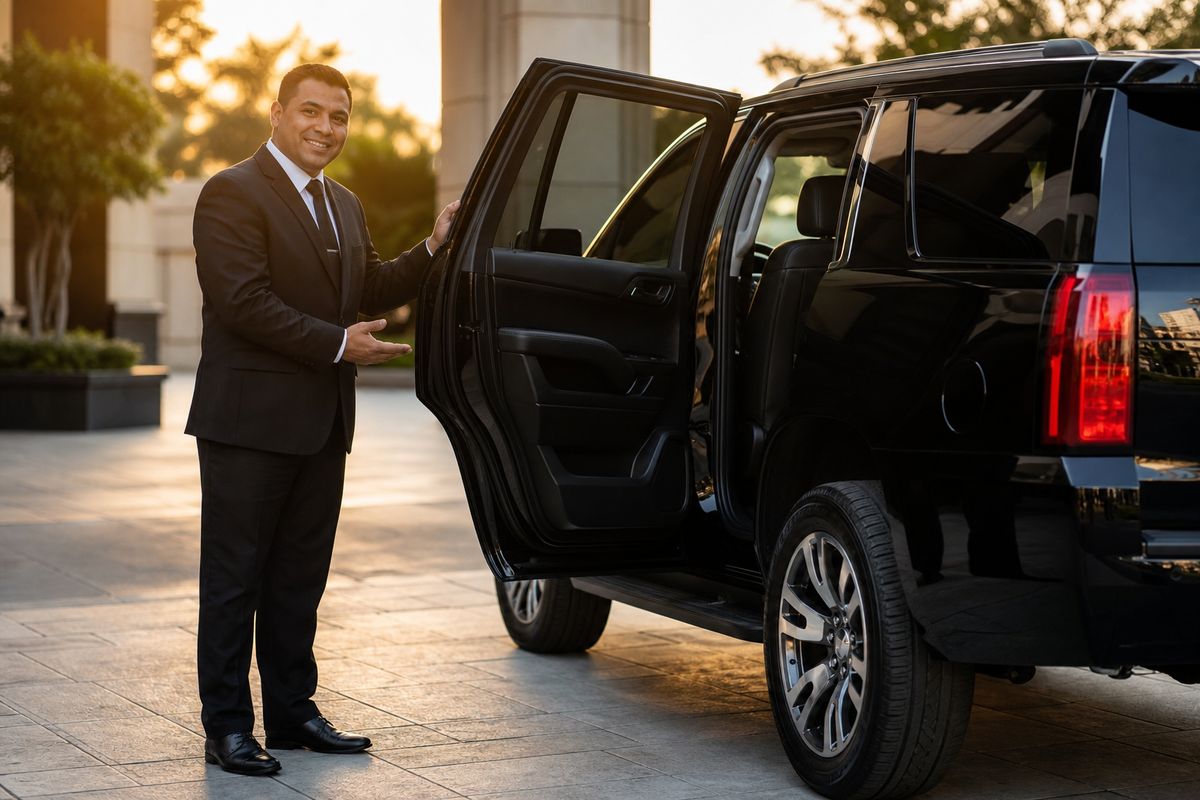
Quick Answer: The biggest etiquette mistakes passengers make with private car services: slamming the door (the chauffeur has it), going silent at pickup time, asking the chauffeur to speed, springing extra stops mid-drive, backseat-driving the route, lighting up without asking, and not knowing the tipping norm (15-20%). None of these are deal-breakers, but avoiding them makes your ride noticeably better.
I'm going to be honest with you.
I will never say anything about any of this in the moment. That's the job. I'll smile, adjust, handle it, and make sure your experience is flawless regardless. Every professional chauffeur does the same.
But after thousands of rides across Colorado, airport runs, wedding shuttles, 14-hour mountain charters, Red Rocks concerts in the rain, I have opinions. Strong ones. And most of the things on this list aren't common knowledge because nobody in this industry talks about them publicly. We just absorb it and move on.
So here it is. Seven things passengers do constantly that make private car service harder than it needs to be. You're not rude for doing any of them. You just didn't know. Now you will.
1. Slamming the Door
This one makes me wince every single time.
You step out of the Navigator, grab the handle, and slam the door like it owes you money. Same force you'd use on your Camry. And I hear the latch mechanism take the hit, and I know exactly what that's going to cost me down the road.
Luxury SUVs have soft-close mechanisms. They're engineered to pull the door shut from a couple inches out. You push it gently, it finishes the job. Quiet, smooth, done. When you slam against that system, you're fighting the mechanism. And when it happens hundreds of times? The latch assembly fails, the seal goes, the motor burns out. On a Navigator, that repair runs about $1,200. I know because I've paid it.
But here's what really gets me: I was walking around to get that door for you. That's literally my job. When you slam it shut before I make it to your side, you've skipped one of the things you're paying for — and damaged the vehicle while doing it.
If you beat me to the door — it happens, no big deal — just push it to the first click and let the soft-close finish. Think hotel room door, not pickup truck.
2. Going Dark at Pickup Time
This one doesn't make me wince. It makes my stomach drop.
Your ride is at 6:00 PM. I arrive at 5:45. Stage the vehicle. Check the climate. Send my text: "Good evening — I'm out front in the black Suburban whenever you're ready."
6:00. Nothing. 6:05. Radio silence. 6:12. I text again. 6:20 — I'm now standing outside a vehicle that's burning fuel, blocking a pickup lane, and I have no idea if you're 30 seconds away or 30 minutes.
I can't leave — you might walk out the second I pull away. I can't call my next client to push their pickup because I don't know when you're coming. Meanwhile, the 7:15 airport client is texting me asking if I'm still good for their flight. They have a 9:00 PM departure. The math is getting tight.
Running late is fine. I genuinely do not care. What I care about is the silence. Because silence turns one late pickup into a domino that hits every client after you. My schedule isn't one ride at a time — it's a chain, and every link depends on the one before it.
"Running 15 behind" — that's all I need. Five words. I adjust, notify dispatch, restructure the evening. Done. It's the silence that kills us.
3. Asking Me to Speed
"Can you step on it? We're running late."
I understand the impulse. I do. You're late for dinner, or you're cutting it close on a flight, and you're sitting behind a guy who seems to be going the exact speed limit. Which I am. Because that's not optional for me.
When you're riding in your own car and you push it to 80 on I-70, the risk is a ticket and some points. When I do it? I'm operating a commercially insured vehicle under a commercial license. One ticket can trigger an insurance audit. An audit can raise premiums for the entire fleet. In some cases, it can threaten the operating authority that lets me do this work at all.
And honestly? I've already accounted for the tight timeline. I left early. I picked a route with fewer signals. I'm doing everything I legally can to get you there. If I'm not speeding, it's because the math doesn't justify it, saving three minutes isn't worth the risk of losing my license.
Tell me the constraint when you get in. "I've got a 7:30 reservation at the Brown Palace." That's useful. I can work with that. But "step on it" puts me in a position where I have to choose between your request and my livelihood. And I'm going to choose my livelihood every time.
4. The "One More Stop" Mentality
"Actually, can we swing by my hotel first?" Twenty minutes later: "Oh wait, I forgot, can we stop at this restaurant?" And then: "You know what, let's just go straight to the airport instead."
One change? Absolutely. Things come up. I get it.
Three changes mid-route? Now I'm replanning everything on the fly while driving a 6,500-pound vehicle through downtown Denver. The route I mapped out — the one that accounted for the construction on I-25, the one-way grid, the parking situation at your destination — that route is gone. I'm improvising now. And improvising on Larimer Street on a Friday night in a full-size Suburban is about as fun as it sounds.
Each "quick stop" also adds time and mileage. Your rate was quoted on a confirmed itinerary. When three new stops show up, I'm either eating the extra cost or having an awkward conversation about the adjusted fare. Neither is great.
I'd rather you tell me everything upfront — even if you're not sure. "I might need to swing by the Ritz on the way" gives me ten minutes to think about logistics. "Actually, take a left here" gives me ten seconds. There's a big difference in the quality of what I can deliver with those two lead times.
5. Giving Me Turn-by-Turn Directions
I'll say it plainly: this is the one that tests my patience the most.
"Take a left here." "Why aren't you taking I-25?" "My phone says this way is faster." "Turn right. No, the other right."
I know you're used to giving directions to Uber drivers. That makes sense. A lot of rideshare drivers are part-time, new to the area, and following whatever Google Maps tells them. Giving them guidance is sometimes the right call.
But I'm not an Uber driver. This is what I do full-time. I monitor real-time traffic across multiple apps. I know which DIA terminal lane moves fastest at which hour. I know the construction zones, the school zones, the speed traps on 285. I know that taking Sixth Avenue instead of I-25 saves twelve minutes on a Tuesday at 5:30 but costs you eight minutes on a Friday at 3:00. I know shortcuts your phone has never heard of because they don't show up on Google's algorithm.
When you override all of that with turn-by-turn instructions from your phone, you're replacing thousands of hours of local experience with an algorithm that doesn't know about the water main break on Colfax. And now if your route hits traffic, I'm stuck in a mess I would have avoided, but can't say that without sounding like I'm blaming you.
If you have a preference, tell me once. "I like taking 36 through Boulder when traffic allows." Perfect. I'll make it happen if I can. But please, let me drive.
6. Lighting Up in the Vehicle
Colorado legalized marijuana in 2012. Vaping is everywhere. And at least a couple times a month, someone in the back seat decides the leather interior of a $100,000 Lincoln Navigator is an appropriate place to light up.
I take this one personally.
Smoke, from cigarettes, vapes, or marijuana — embeds in leather, fabric headliners, and HVAC systems. One session. That's all it takes. Standard detailing won't touch it. The only fix is a professional ozone treatment, which takes 12 to 24 hours and pulls the vehicle completely out of service. That's a full day of bookings lost. Clients rescheduled. Revenue gone.
And the next passenger who gets in? They didn't sign up to smell what the last person smoked. Maybe they have asthma. Maybe they have a client meeting in 20 minutes. Maybe they just don't want their suit jacket smelling like someone else's choices. One person's decision ripples through the next five clients who sit in that same seat.
Don't smoke. Don't vape. Don't crack the window and think that makes it okay — it doesn't. If you need to smoke, tell me. I'll pull over at a safe spot. It adds two minutes to the ride. That's a trade I will happily make.
7. The Awkward Tip Moment
I'm going to be straight with you about this because most articles dance around it.
You've arrived. I've got your bags on the curb, the door is open, the ride went great. And now you're frozen. I can see it on your face. Do I tip? How much? Cash? Is it included? Do I just... hand it over?
Here's the deal: tipping is standard in this industry. It's usually not baked into the rate. And the norms are pretty simple:
- Airport transfer or point-to-point: 15-20%
- Multi-hour event (weddings, concerts, corporate outings): 18-20% — I committed my entire evening to your schedule
- Mountain transfers (DIA to Vail, Aspen, Breckenridge): 18-20% — this drive involves real skill, especially in winter. I've white-knuckled I-70 through Eisenhower Tunnel in a whiteout so you didn't have to.
- Multi-day service: Tip daily or at the end. For strong service, 20-25% is what I typically see.
Cash works. Adding it to the invoice works. Venmo works. There's no wrong format. Just don't make it complicated in your head — treat it like a restaurant. Good service, 20%. Fine service, 15%. And during holidays, Christmas, New Year's, Fourth of July — a lot of regulars bump it up because they know I'm working when everyone else is at home with their family. That means something.
I will never make the tip moment awkward. That's on me. But I'm telling you the truth: it matters. This is how I make a living.
Here's Why I Wrote This
Every item on this list? I handle it without blinking. That's the gig. I don't make faces. I don't lecture. I don't give you attitude. You will never know I noticed.
But I noticed.
And I'm writing this because I think most people would change these things if they knew. Not because I told them to — because they'd want to. Most passengers who slam the door don't know about the soft-close mechanism. Most people who go dark at pickup don't realize the domino effect. Most backseat drivers don't mean to be disrespectful — they just don't know the difference between a chauffeur and a rideshare driver yet.
So now you know. And the next time you step into a private car, you'll be the kind of passenger who makes a chauffeur's night better instead of harder. That costs you nothing. And I promise you — you'll feel the difference in the service you get back.
If you want to take it even further, I wrote a follow-up about what separates a regular passenger from the kind of client chauffeurs actually fight over: How to Be a 5-Star Private Car Service Client.
Ready to See How It's Supposed to Work?
Book with Arion and skip the learning curve. We handle the doors, the luggage, the route, and the timing. You just get in.
Book Your RideOr call 970-703-4995