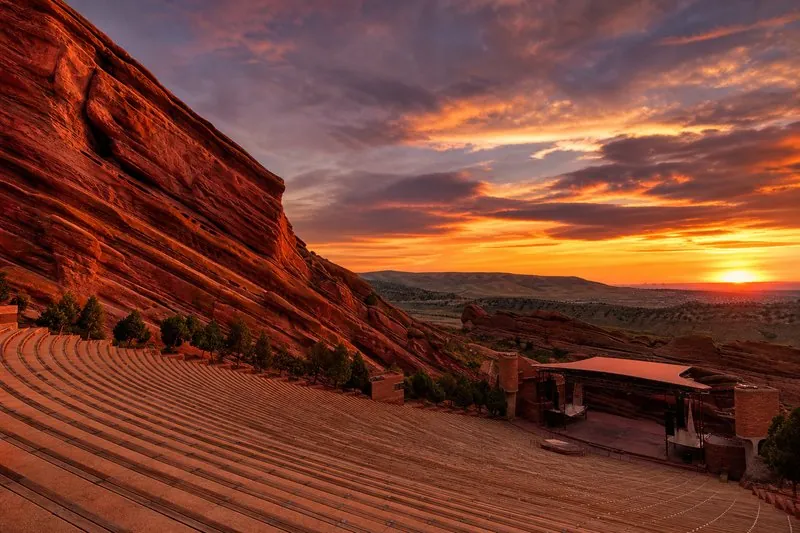
Quick Answer: There are great concert venues. There are legendary concert venues. And then there's Red Rocks. The distinction matters.
There are great concert venues. There are legendary concert venues. And then there's Red Rocks.
The distinction matters. A great venue has good sound and comfortable seats. A legendary venue has history and atmosphere. Red Rocks has all of that—plus 300-million-year-old sandstone monoliths, dinosaur tracks, and acoustics that a Scottish opera singer declared perfect in 1911 and that no architect, engineer, or technology has managed to duplicate in the century since.
This isn't a guide to attending Red Rocks (we've written that elsewhere). This is the story of why Red Rocks exists in a category of one—why it's a venue you should visit and a place that changes the way you think about what live music can be.
Born Before the Dinosaurs: The Geological Story
Before Red Rocks was a concert venue, it was an inland sea.
Approximately 300 million years ago, during the Pennsylvanian Period, what is now Colorado was not landlocked but surrounded by ancient oceans. Those seas, rising and falling over millions of years, deposited layers of sand, silt, and sediment that slowly compressed into the thick sandstone formations visible today. The Fountain Formation—the geological layer that comprises Red Rocks' iconic monoliths—was born from sediment washed out of the Ancestral Rocky Mountains, a predecessor range that paralleled today's Front Range before eroding away entirely.
Then, approximately 65 million years ago, the Laramide Orogeny—the geological upheaval that created the current Rocky Mountains—tilted the Fountain Formation beds on their edges, exposing layers of stone that had been buried for eons. Over the next tens of millions of years, wind and water sculpted these tilted beds into the dramatic formations that exist today.
Related reading: Best Bars Near Red Rocks (Before & After Concerts)
The result: two 300-foot monoliths, Ship Rock and Creation Rock, flanking a natural amphitheatre bowl. Both monoliths are taller than Niagara Falls. The sandstone varies from light gray to pale red to deep rust, colored by iron oxide percolating through the rock over geological timescales. The characteristic reddish-pink hue isn't paint—it's iron literally rusting inside 300-million-year-old stone.
Near the entrance to the amphitheatre, a bronze plaque marks the contact between the 1.7-billion-year-old Precambrian basement rock and the "newer" Fountain Formation. Between these two rock layers lies a 1.2-billion-year gap—an unconformity where the geological record vanishes, part of a global phenomenon scientists call the Great Unconformity.
Dinosaur tracks are still visible at nearby Dinosaur Ridge. Fossil fragments of a 40-foot Plesiosaur—a marine reptile—have been discovered at the site. When you sit in Row 35 watching a sunset concert, you're sitting inside a geological record that spans 300 million years of Earth's history.
Red Rocks was once listed among the Seven Wonders of the World. It's easy to understand why.
120 Years of Music: From Brass Bands to Global Headliners
1906: The Beginning
On May 31, 1906, magazine publisher John Brisben Walker hosted the Grand Opening of the Garden of the Titans, featuring Pietro Satriano and his 25-piece brass band. It was the first documented public performance at the natural amphitheatre, and it set the stage—literally—for more than a century of musical history.
Walker, who had purchased the land with proceeds from selling Cosmopolitan magazine, envisioned transforming the natural formation into a top-tier symphonic venue. He built a temporary performance platform and even constructed the Mount Morrison Cable Incline funicular railway to carry tourists to the top of Mount Morrison.
1911: The Acoustic Discovery
The moment that defined Red Rocks' destiny came on May 10, 1911, when Scottish opera singer Mary Garden performed the venue's first solo concert. After singing "Annie Laurie" and Schubert's "Ave Maria" in the natural amphitheatre, Garden made a declaration that still echoes:
Related reading: Colorado Concert Weather: What to Expect Month by Month
"Never in any opera house the world over have I found more perfect acoustic properties. Never under any roof have I sung with greater ease or had a greater delight in singing. I predict that someday, 20,000 people will assemble here to listen to the world's greatest masterpieces."
She was close—the venue's current capacity is 9,525, and it now hosts over 160 concerts per year.
1927–1941: Building the Amphitheatre
Denver purchased the Red Rocks property in 1927 for $54,133. After the stock market crash delayed construction, the Civilian Conservation Corps (CCC) and Works Progress Administration (WPA) began building the amphitheatre in 1936 as part of President Roosevelt's New Deal.
Modeled after the ancient amphitheatre at Taormina in Sicily, the project required 800 tons of quarried stone, 30,000 pounds of reinforced steel, and the labor of 500 young CCC workers who carved, hauled, and laid over 90,000 square feet of Lyons sandstone—chosen for its reddish color and texture that matched the natural formations. The materials cost $115,881.87. The labor, paid by the federal government, amounted to $357,281.69.
What was estimated to take two years took five.
On June 15, 1941, the amphitheatre was officially dedicated in a ceremony broadcast over the Columbia Broadcasting System. Music critic Olin Downes wrote in the New York Times: "Nothing in the U.S. Could equal the beauty and scenery of the outdoor theater."
1964: The Beatles Rock the Rocks
On August 26, 1964—six months after their legendary Ed Sullivan Show appearance—The Beatles played Red Rocks. It was the only concert that didn't sell out on their first U.S. Tour, drawing approximately 7,000 fans at $6.60 per ticket. It was also the first and last time the Beatles played in Colorado.
Beatles drummer Ringo Starr later recalled: "I remember it was very high and the air was thin. They were giving us hits from oxygen canisters." When Starr returned with his All-Starr Band on June 28, 2000, he asked the crowd if anyone had been at the original Beatles show thirty-six years earlier.
The show set a box office record for an open-air venue and marked the beginning of Red Rocks' transformation from a classical and community venue into a rock-and-roll destination.
1968: Hendrix at the Rocks
On September 1, 1968, Jimi Hendrix performed at Red Rocks alongside Vanilla Fudge and Soft Machine, selling out the venue at $5 per ticket. It was the first Red Rocks show booked by legendary concert promoter Barry Fey, who would go on to shape the venue's identity for decades.
The Hendrix show at Red Rocks is one of the most storied concerts in rock history—and one of the most mysterious. No known photographs or audio recordings of the performance exist. The concert lives entirely in the memories of those who were there. Hendrix is said to have written lyrics for "Have You Ever Been (to Electric Ladyland)" that same night at a Denver hotel.
1971 & 1976: The Rock Bans
Red Rocks' relationship with rock and roll hasn't always been smooth. In 1968, a contract dispute led Aretha Franklin to refuse to perform, and fans stormed the stage and destroyed a piano, prompting a one-year ban on rock concerts in 1969.
The more infamous incident came on June 10, 1971, when approximately 1,000–2,000 ticketless fans showed up to a sold-out Jethro Tull show. When they tried to breach the police line, tear gas was deployed, and the resulting clash led to a five-year ban on rock at Red Rocks—effectively exiling the most important musical movement of the era from one of its most perfect stages.
Concert promoter Barry Fey legally challenged the ban in 1975, and the courts ruled the city had acted "arbitrarily and capriciously." Rock returned in the summer of 1976, and it has never left.
1983: The Night That Changed Everything
On June 5, 1983, U2 performed at Red Rocks during their War Tour. It rained. Hard. The venue had been sold out, but the crowd thinned to approximately 4,400 as fans assumed the show would be canceled.
The show was not canceled.
U2 had invested in filming crews and equipment to create a concert video, and they couldn't get their money back. Bono himself walked into the parking lot and crowd, urging attendees to ignore their seat assignments and move forward to make the house seem full for the cameras.
What followed was one of the most iconic performances in rock history. Bono, singing "Sunday Bloody Sunday" while waving a white flag through crimson mist—created by rain, hot stage lights, and the illumination of the red sandstone—became the defining image of U2's career and one of the most replayed concert moments of the decade.
The resulting concert film, U2 Live at Red Rocks: Under a Blood Red Sky—aired in heavy rotation on MTV and became a best-seller. Rolling Stone named the performance of "Sunday Bloody Sunday" one of the "50 Moments That Changed the History of Rock and Roll."
As Pitchfork later wrote: "When the group performed at Red Rocks on a rainy June night, with lit torches above a panoramic skyline, the venue provided an ideal backdrop for U2's literally flag-waving music, with everything—earth, wind, fire—in place to maximize and heighten the drama of the moment."
The concert didn't just launch U2 into global superstardom. It launched Red Rocks into global consciousness. The venue's official website acknowledges that the U2 performance "paved the way for other great artists to record live concert videos at Red Rocks, and helped the Amphitheatre gain its reputation as one of the top venues in the world."
The Live Album Legacy
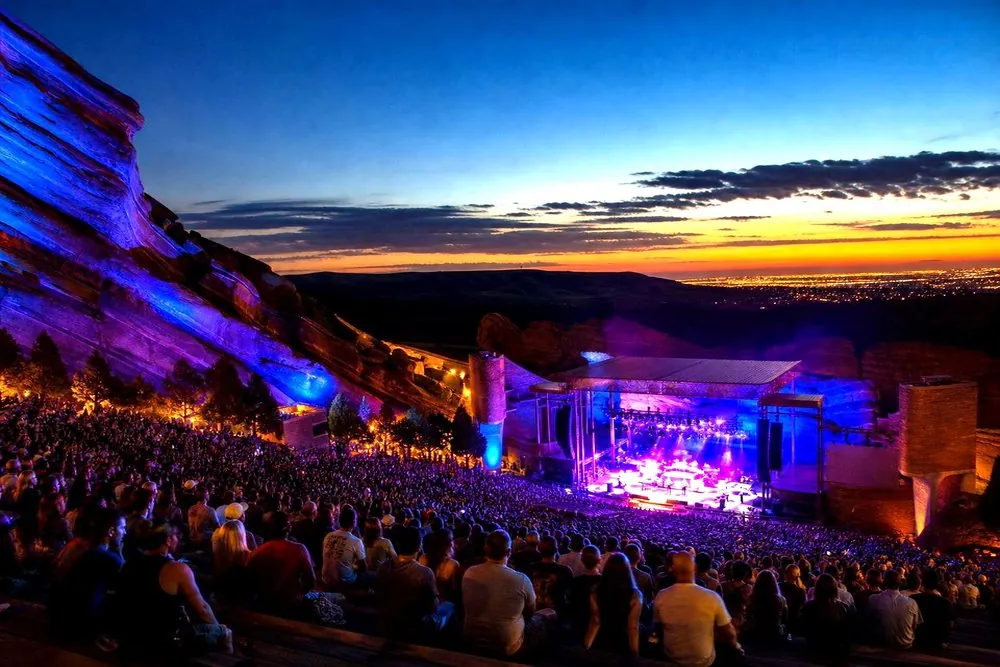
Red Rocks doesn't just host concerts—it records them. Its natural acoustics capture performances with a fidelity studio settings struggle to match. Notable recordings include:
- U2Under a Blood Red Sky (1983)
- The Moody Blues — A Night at Red Rocks with the Colorado Symphony Orchestra (1992), their first-ever symphony performance, aired on PBS
- Dave Matthews Band — Weekend on the Rocks (2005), a CD/DVD from a four-night run
- Incubus — Alive at Red Rocks (2004)
- Mumford & Sons — The Road to Red Rocks (2012), plus the official "I Will Wait" music video
- Stevie NicksDepeche ModeVance JoyBill Burr — All chose Red Rocks for concert films and specials
The amphitheatre's own compilation series, Carved in Stone—features never-released live performances by Blues Traveler, Stevie Ray Vaughan, Jack Johnson, Tori Amos, R.E.M., and The Allman Brothers Band.
What Artists Say About the Stage
The ultimate measure of a venue's status isn't what critics write or what audiences review. It's what artists say about performing there. And at Red Rocks, the verdict is unanimous.
Related reading: Concert Date Night Itinerary: Red Rocks Edition
Mary Garden (1911): "Never in any opera house the world over have I found more perfect acoustic properties."
Related reading: Concert Packing List for a Red Rocks Trip
Ringo Starr (recalling the Beatles' 1964 show): "I remember it was very high and the air was thin. They were giving us hits from oxygen canisters."
Geddy Lee of Rush: "It's an amazing location. One of the most stunning concert venues in the United States,or anywhere. I would hazard a guess that it's one of the most beautiful places in the world."
Keith Moseley of String Cheese Incident: "The intensity at Red Rocks is different. You look up there and everyone's looking down at you, framed by the giant rock monoliths."
Bill Nershi of String Cheese Incident: "The energy gets funneled down from the crowd to the stage. And you walk out onto the stage and you look and it's everybody—just a wall of people above you."
James Taylor reportedly declared "there was no better place in the universe to play a show than Red Rocks."
Artists don't just play Red Rocks. They dream of it. String Cheese Incident, before they'd ever been booked there, drove to the empty amphitheatre, stood on stage, and visualized making it happen: "Stand where you think you would be standing in the show, look up at the seats, and just say, 'We're gonna do this!'" They've now played Red Rocks 45 times.
Awards, Records, and Cultural Recognition
The accolades tell the story of a venue that has no peer:
- Pollstar's Best Outdoor Venue: Won so many consecutive years that the award was effectively retired, renamed, and given to other venues so they could have a chance.
- 2021: Named the top-grossing and most-attended concert venue of any size worldwide.
- 1957: Selected by the American Institute of Architects as Colorado's entry for the AIA's Centennial Exhibition at the National Gallery of Art.
- 1973: Designated an official Denver Landmark.
- Rolling Stone: Named "Best Outdoor Concert Venue" in the nation.
- National Register of Historic Places: Red Rocks Park was placed on the register as part of the Morrison historic district.
- Recently added to the National Historic Register in its own right.
What Makes It Bucket List—Not Just "Great"
Many venues are worth visiting. Only a handful are worth planning a trip around. Red Rocks crosses that threshold for a specific set of reasons:
It cannot be replicated. Every element that makes Red Rocks extraordinary—the 300-million-year-old monoliths, the natural acoustics, the elevation, the geological formations—is the product of forces that operated over timescales no human construction can match. You can build a better arena. You cannot build another Red Rocks.
Related reading: Denver Weekend Itinerary Built Around a Concert at Red Rocks
It carries the weight of history. When you sit in those stone seats, you're occupying the same space where Beatles fans screamed in 1964, where U2 played through rain and fire in 1983, where Hendrix performed a show that exists only in memory. The backstage stairway to the stage is covered in signatures and inscriptions from decades of performers. History is literally written on the walls.
It connects you to something ancient. The rock beneath your feet is older than the dinosaurs whose tracks are preserved nearby. The venue sits where the Great Plains meet the Rocky Mountains—a border between ecosystems that has existed for millions of years.
It changes the music. The natural acoustics, elevation, and visual drama raise every artist, every genre, every note. Musicians perform differently here because the venue demands it.
The experience extends beyond the stage. Red Rocks isn't a building—it's a mountain park with hiking trails, a Visitor Center, a Trading Post with the free Colorado Music Hall of Fame, and geological formations to explore. The concert is the centerpiece, but the experience is all-encompassing.
Making the Bucket List a Reality
The gap between "I should go to Red Rocks someday" and "I went to Red Rocks last night" is smaller than most people think. Denver International Airport is 45 minutes away. The concert season runs May through October, with over 160 shows per year spanning every genre from EDM to country, classical to comedy.
The one piece of advice that every visitor echoes: don't add stress to the experience. The stairs are real. The altitude is real. The parking is unpredictable. The post-show traffic can test your patience on dark mountain roads.
The solution is simple: let someone else handle the logistics. Arion, LLC provides door-to-door concert transportation with drop-off at the Top Circle Lot.the most convenient entrance—and pickup that bypasses the post-show parking chaos entirely. The drive to Red Rocks, through the glowing sandstone formations of the foothills, becomes the opening act rather than a source of stress.
Related reading: How Altitude Affects Your Concert Experience at Red Rocks
Because a bucket list experience deserves a bucket list arrival.
Frequently Asked Questions
What vehicles does Arion offer?
Arion's fleet includes Executive and Luxury SUVs, Luxury Sedans, Luxury Coach Vans for groups up to 12, and party buses for larger groups. Every vehicle is commercially insured and maintained to the highest standards.
Does Arion provide door-to-door service?
Yes. Arion provides true door-to-door transportation — from your home, hotel, or the airport directly to Why Red Rocks Is a Bucket List Venueacy. No shared rides, no extra stops, no waiting.
What areas does Arion serve?
Arion serves Denver International Airport, the Denver metro, the Front Range from Colorado Springs to Fort Collins, and the mountain corridor including Vail, Beaver Creek, Breckenridge, Keystone, Copper Mountain, Winter Park, Steamboat and Aspen.
Before the Concerts… There Was Energy
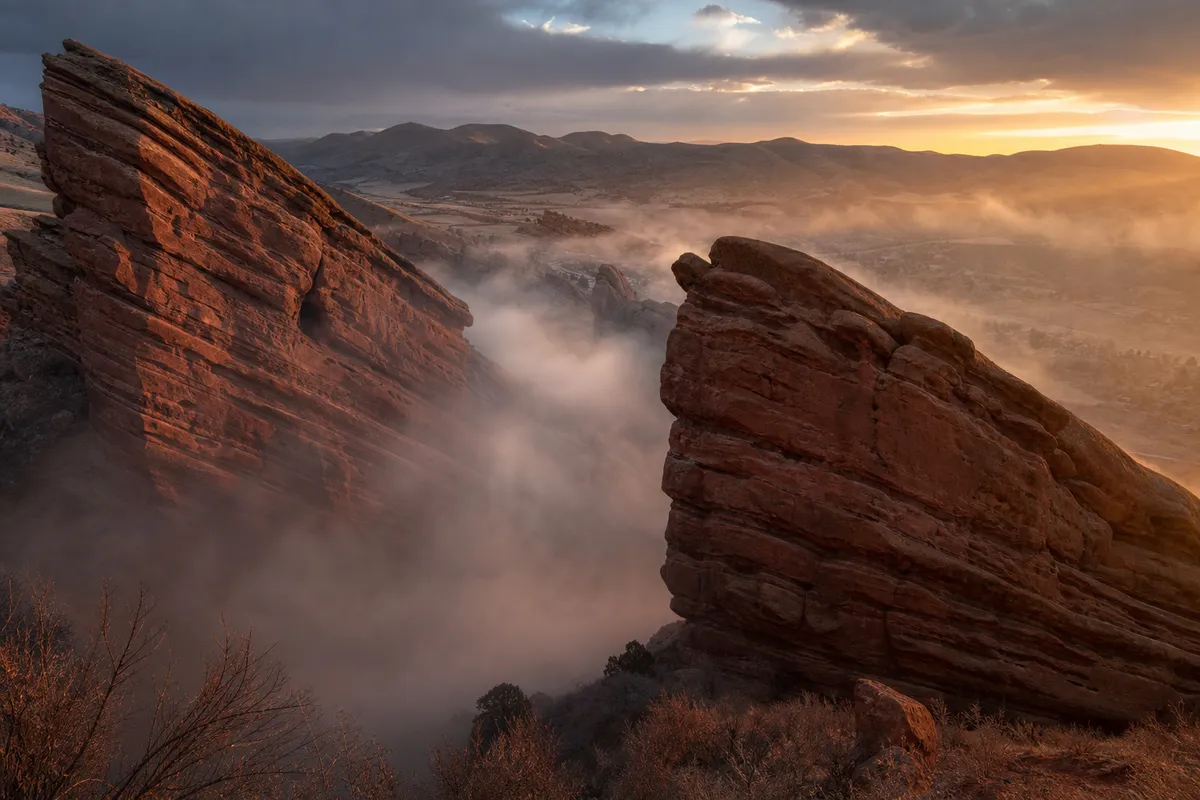
Long before Red Rocks became one of the most famous music venues on Earth, it was already legendary.
Not because of artists.
Not because of lights.
Related reading: Best Bars Near Red Rocks (Before & After Concerts)
Not because of sold-out shows.
Because of the rocks themselves.
These formations are around 300 million years old. Think about that for a second. Empires came and went. Entire civilizations disappeared. And those sandstone giants were just sitting there watching all of it happen.
Indigenous tribes including the Ute, Cheyenne, and Arapaho moved through the area long before Colorado existed as we know it today. Many believed the space carried spiritual significance. And honestly, if you've ever stood inside Red Rocks during a storm or watched sunrise break across the amphitheater, you understand why immediately.
There's a feeling there that's hard to explain unless you've experienced it yourself.
People still talk about it constantly:
- "The energy."
- "The vibe."
- "The atmosphere."
- "Something about that place."
And no matter how modern the venue becomes, that feeling never leaves.
The 1920s: Denver Realizes It Has Something Special
Back in the 1920s, Red Rocks wasn't yet the global icon it is today. It was mostly known as an unbelievably beautiful natural gathering space outside Denver where small performances and community events happened among the rocks.
But city leaders started realizing something important:
If they didn't protect Red Rocks, someone else would commercialize it into oblivion.
Related reading: Colorado Concert Weather: What to Expect Month by Month
So in 1927, Denver purchased the land surrounding the formations.
And honestly? That decision may have been one of the smartest long-term investments Colorado ever made.
Because instead of flattening the terrain and building over nature, Denver decided to build with it.
That changed everything.
Then the Great Depression Accidentally Created a Masterpiece
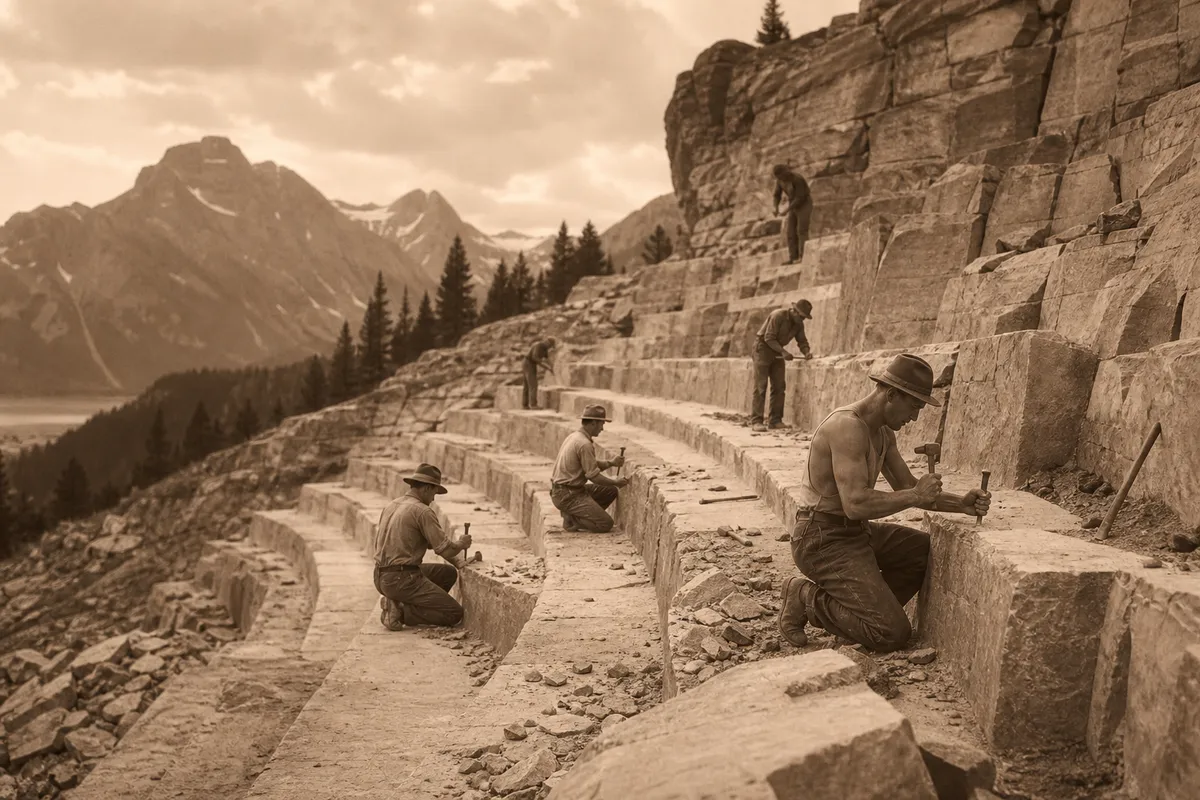
Here's where the story gets wild.
During the 1930s, while America was struggling through the Great Depression, Red Rocks became one of the most ambitious public construction projects in the country.
The Civilian Conservation Corps (CCC) and Works Progress Administration (WPA) sent workers into the foothills to carve an amphitheater directly into the mountain landscape.
Related reading: Concert Packing List for a Red Rocks Trip
Imagine showing up to work every day carrying stone through steep mountain terrain at altitude with 1930s equipment.
No modern machinery.
No advanced technology.
Just grit.
And somehow those crews created one of the most acoustically perfect outdoor venues in the world.
What makes Red Rocks brilliant is that the architecture never tries to overpower nature. The rocks remain the star of the show. The venue blends into the environment instead of competing with it.
That's why Red Rocks still feels timeless while so many venues age out culturally after twenty years.
The Urban Legends Started Early
Now this is where Red Rocks stops being just history and starts becoming mythology.
Because every legendary place develops stories.
And Red Rocks has a lot of them.
Related reading: Denver Weekend Itinerary Built Around a Concert at Red Rocks
There's the old rumor that whispers travel unnaturally between the rocks late at night.
There are stories from staff who swear they've heard music echoing through the amphitheater hours after everyone left.
Some people claim the venue has hidden tunnels beneath it from the WPA construction era.
Others insist storms "avoid" Red Rocks during major shows, which honestly sounds ridiculous until you watch lightning surround the venue while the concert somehow keeps going untouched.
And then there's the biggest legend of all:
That Red Rocks changes performers.
Not metaphorically.
Emotionally.
Artists talk about Red Rocks differently than almost any other venue on Earth. Some say playing there feels spiritual. Others say it feels intimidating in the best possible way, like the venue itself demands something from you.
And if you've ever watched an artist walk onto that stage for the first time and pause to stare at the crowd and the rocks behind them…
…you can literally see the moment it hits them.
The 1960s: Red Rocks Becomes Rock and Roll Royalty
Then came the 1960s.
And suddenly Red Rocks went from "beautiful Colorado venue" to holy ground for live music.
The Beatles played there in 1964 during absolute peak Beatlemania.
Related reading: How Altitude Affects Your Concert Experience at Red Rocks
Johnny Cash performed there.
Jimi Hendrix lit the place up.
Diana Ross and The Supremes brought Motown into the mountains.
And once those performances happened, word spread fast throughout the music world:
Red Rocks was different.
Not just visually.
Emotionally.
Artists started talking backstage about how crowds felt more connected there. Fans described concerts like life events instead of entertainment.
Because Red Rocks doesn't just create sound.
It creates atmosphere.
The Night Chaos Hit the Mountain
In 1971, Red Rocks experienced one of the most infamous nights in its history during a Jethro Tull concert.
The venue became overcrowded. Thousands attempted to force entry. Police deployed tear gas outside the amphitheater as chaos unfolded in the surrounding areas.
For a moment, it looked like Red Rocks might lose its future as a rock venue entirely.
Related reading: How to Plan the Perfect Concert Night in Denver
The city temporarily banned rock concerts afterward.
But instead of hurting the venue's reputation, the incident almost added to its mythology.
Because by then Red Rocks had become bigger than policy decisions.
It had become symbolic.
Freedom.
Music.
Rebellion.
Experience.
The kind of place people talked about long after the concert ended.
Then U2 Changed Everything
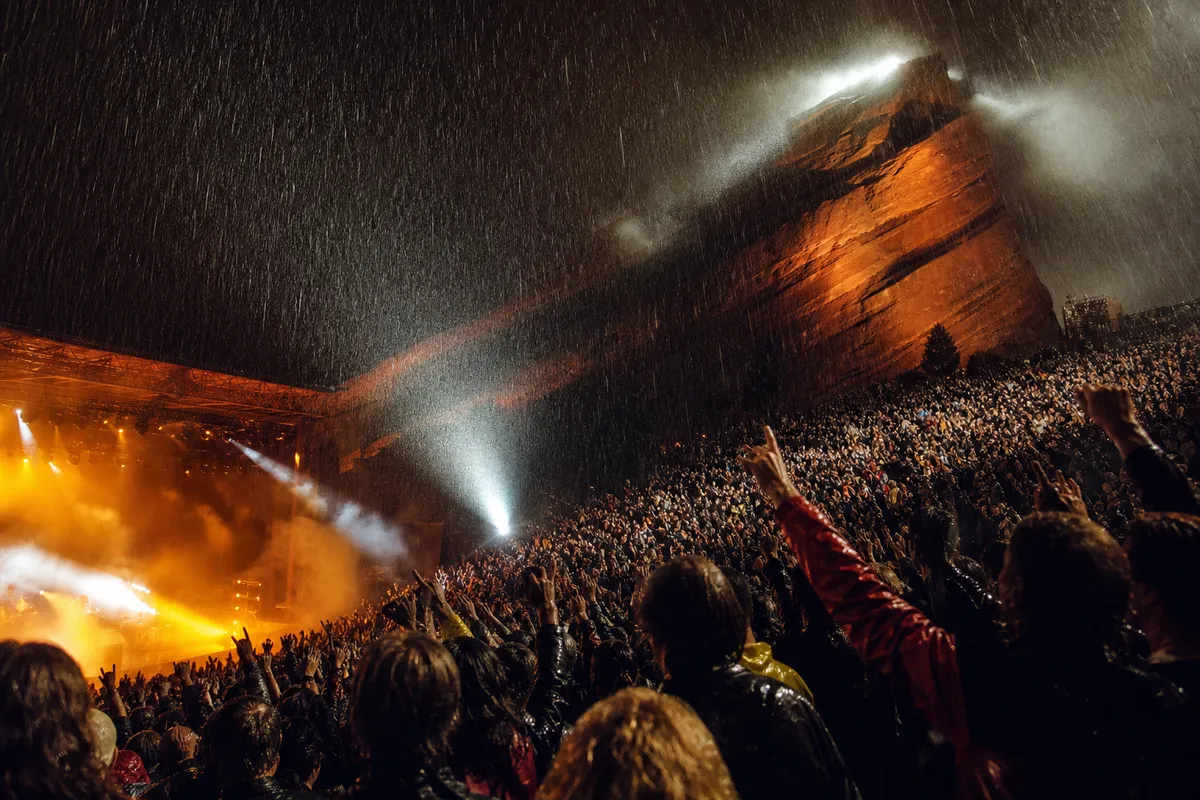
If Red Rocks was already famous before the 1980s…
U2 turned it into legend.
Their 1983 Under a Blood Red Sky performance became one of the most iconic live concert films ever made.
Related reading: What It Feels Like to Experience a Concert at Red Rocks
Rain poured through the canyon.
Fog wrapped around the stage.
Torches burned against the rocks.
The crowd looked electric.
It didn't even feel real.
That performance introduced Red Rocks to millions of people worldwide who had never seen anything like it before.
And after that?
Every major artist wanted to play Red Rocks.
Because by then it wasn't just another venue on tour.
It was a bucket-list experience.
Why Red Rocks Still Wins Today
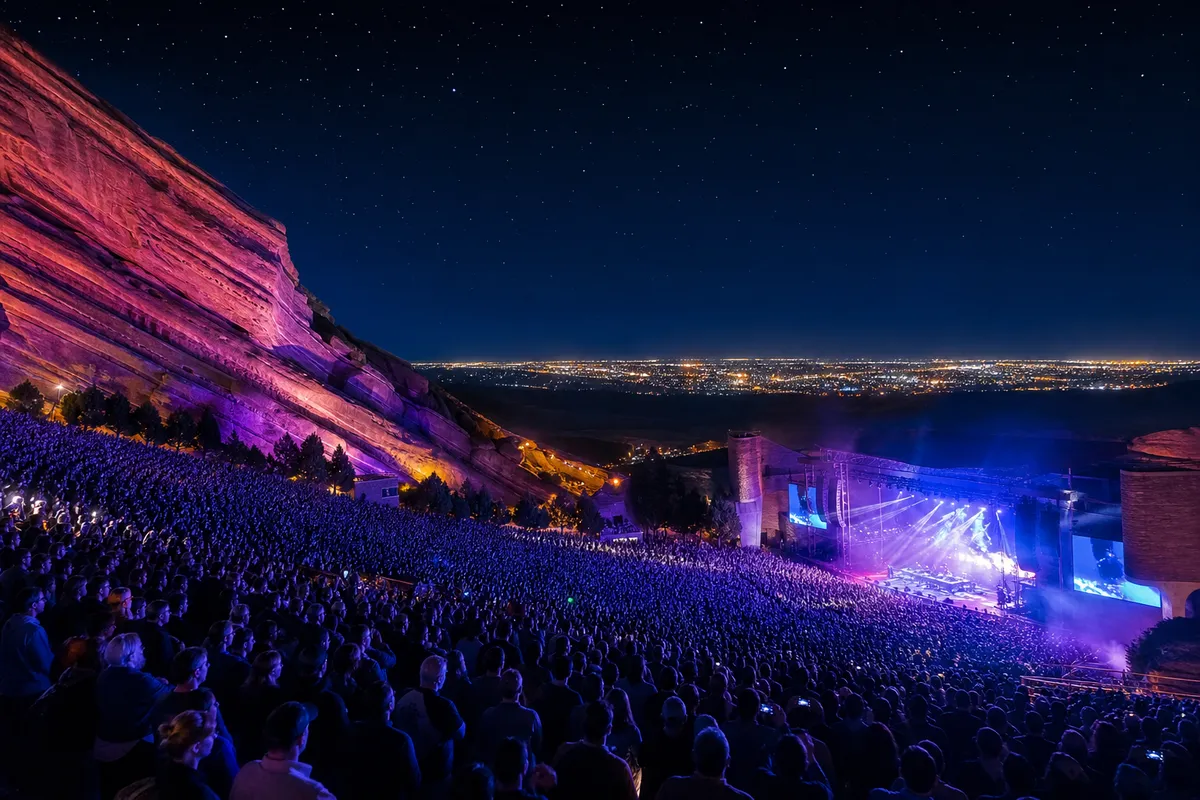
Here's the crazy part:
Even now — in an era of billion-dollar stadiums, insane LED screens, AI-generated visuals, and hyper-produced entertainment — Red Rocks still feels ahead of everyone else.
Because technology can replicate spectacle.
Related reading: Where to Eat Before a Red Rocks Concert
It can't replicate atmosphere.
You can't manufacture:
- ancient stone,
- mountain weather,
- altitude,
- natural acoustics,
- emotional history,
- or millions of memorable moments layered into one place over generations.
That's why Red Rocks still hits differently.
It's not just a venue.
It's a feeling.
And honestly?
That feeling starts long before the music ever does.
Experience Red Rocks the Way It Deserves
A place this legendary deserves more than a rideshare and a parking lot scramble.
When you're heading to Red Rocks, the journey should feel like part of the experience. Not something you endure to get there. A luxury ride through the foothills at sunset, arriving relaxed and ready, leaving after the encore without a single thought about traffic or parking.
That's what Arion does. Door-to-stage luxury transportation for the venue that demands nothing less.
Because you matter, and so does how you get there.
Keep Exploring Red Rocks
- Red Rocks Concert Schedule 2026: Full Lineup + Insider Tips
- Is Red Rocks Worth It? The Real Experience Explained
- Best Seats at Red Rocks: Where to Sit for Every Vibe
- Red Rocks Tips First Timers Need to Know
- What to Bring to Red Rocks: The Essential Checklist
- What to Wear to Red Rocks: A Complete Style & Weather Guide
- Why Parking at Red Rocks Can Ruin Your Night
- From Door to Stage: How a Luxury Ride Changes Your Red Rocks Experience
- Best Hotels Near Red Rocks
References
- Red Rocks Amphitheatre — Official Website
- National Park Service Archives
- Colorado Encyclopedia — Red Rocks Park & Amphitheatre
- Denver Public Library Historical Collections
- Colorado Music Hall of Fame
- Historical WPA & CCC records
- Oral folklore and Colorado urban legends
- National Geographic features on Red Rocks
For the complete picture, see our The Guide to Colorado Concerts (2026 Edition).
Related reading: Denver to Red Rocks: Routes, Drive Times, and Transportation Options
Your Red Rocks night, handled.
Planning something important? Arion provides luxury transportation and chosen travel experiences built around care, discretion, and the belief that every guest should feel considered from the first conversation to the final drop-off.
The Crown Jewel: Red Rocks Amphitheatre
You can't talk about Colorado's concert scene without starting here. Red Rocks Amphitheatre in Morrison seats 9,525 between two 300-foot sandstone monoliths formed over 250 million years ago. The Beatles played here in 1964. U2 filmed the concert video that made them global superstars here in 1983. In 2021, it was named the top-grossing and most-attended concert venue of any size worldwide.
But what makes Red Rocks the standard against which all other venues are measured isn't its history or its capacity. It's the experience—the way the natural acoustics turn every performance into something that sounds like it was mixed by God, the way the Denver skyline emerges behind the stage as the sun sets, the way the ancient stone seems to vibrate with the music.
Red Rocks is the reason many people come to Colorado for live music. The venues below are the reason they stay.
Denver's Urban Venue Circuit
Denver alone has over 76 live music venues—ranking it alongside Nashville, Portland, and New Orleans among America's densest live music cities. The scene is concentrated in two main corridors, each with its own character.
The Bluebird District (East Colfax)
Bluebird Theater — 550 capacity
Built in 1913 as a movie house and reopened in 1994 as a music venue, the Bluebird is Denver's most intimate mid-size room. The tiered layout means there are no bad sightlines. The neon marquee on Colfax is iconic. Few people know it was formerly a porn theater, a fact that somehow makes it more endearing. The Bluebird is where you see tomorrow's headliners today, in a room so close you can count the strings on the guitar.
Related reading: The Vehicle Is the Easy Part
Ogden Theatre1,600 capacity
Dating back to 1919, the Ogden is a powerhouse that hosts over 150 shows a year spanning rock, hip-hop, electronic, and everything in between. General admission only, which keeps the energy democratic—everyone fights for the same floor space. The Ogden sits one block from the Fillmore, creating a natural venue-hopping corridor on show nights.
Fillmore Auditorium — 3,900 capacity
The largest general admission venue in Colorado, the Fillmore fills the gap between club shows and arena concerts. Stunning chandeliers hang from the ceilings of the expansive main floor, and the upper level offers breathing room when the floor becomes a mosh pit. It's the room where EDM shows, hip-hop blowouts, and big-name rock tours all feel equally at home.
South Broadway
Gothic Theatre. 1,100 capacity
Like the Bluebird, the Gothic started as a movie theater—in fact, it showed the first "talkies" in Denver in the 1920s. The 1998 renovation preserved the historic interior while converting it into one of the most versatile venues in the state. The room covers everything from indie to electronic, folk to metal, with a layout that gives patrons room to both stand and sit. It's the venue that Denver musicians cite most often as the one that "feels right."
Hi-Dive285 capacity
One of the most beloved concert venues on South Broadway. The Hi-Dive is a launching pad for rising stars and a staple of Denver's alt-rock scene. The intimacy is extreme—at 285 capacity, you're essentially at a house party with professional sound. This is where you come when you want to see an artist before they sell out Red Rocks.
RiNo and LoDo
Mission Ballroom. 3,950 capacity
Opened in Denver's River North Art District, the Mission Ballroom is the state's most technologically advanced venue. Its signature feature is a moving stage that can shift position during a show. The state-of-the-art acoustics are designed to provide arena-quality sound in a general-admission setting. It's Denver's answer to Brooklyn Steel or The Anthem in D.C.—the room where every tour wants a date.
Ball Arena. 18,000 capacity
Denver's largest venue handles the stadium-level acts—the arena tours, the massive productions, the shows that need 18,000 seats. Originally opened in 1999 with a Celine Dion concert, Ball Arena is where you see the Beyoncés and Taylor Swifts of the world. It lacks the intimacy of smaller rooms, but compensates with sheer spectacle.
Cervantes' Masterpiece Ballroom & The Other Side — 400–1,000 capacity
A two-room complex in Five Points that's become ground zero for Denver's hip-hop, EDM, and funk scenes. The main room hosts touring acts; The Other Side handles smaller, more experimental shows. The dual-room format means you can hear two completely different genres in the same building on the same night.
The Jazz and Specialty Scene
Dazzle — 200 capacity
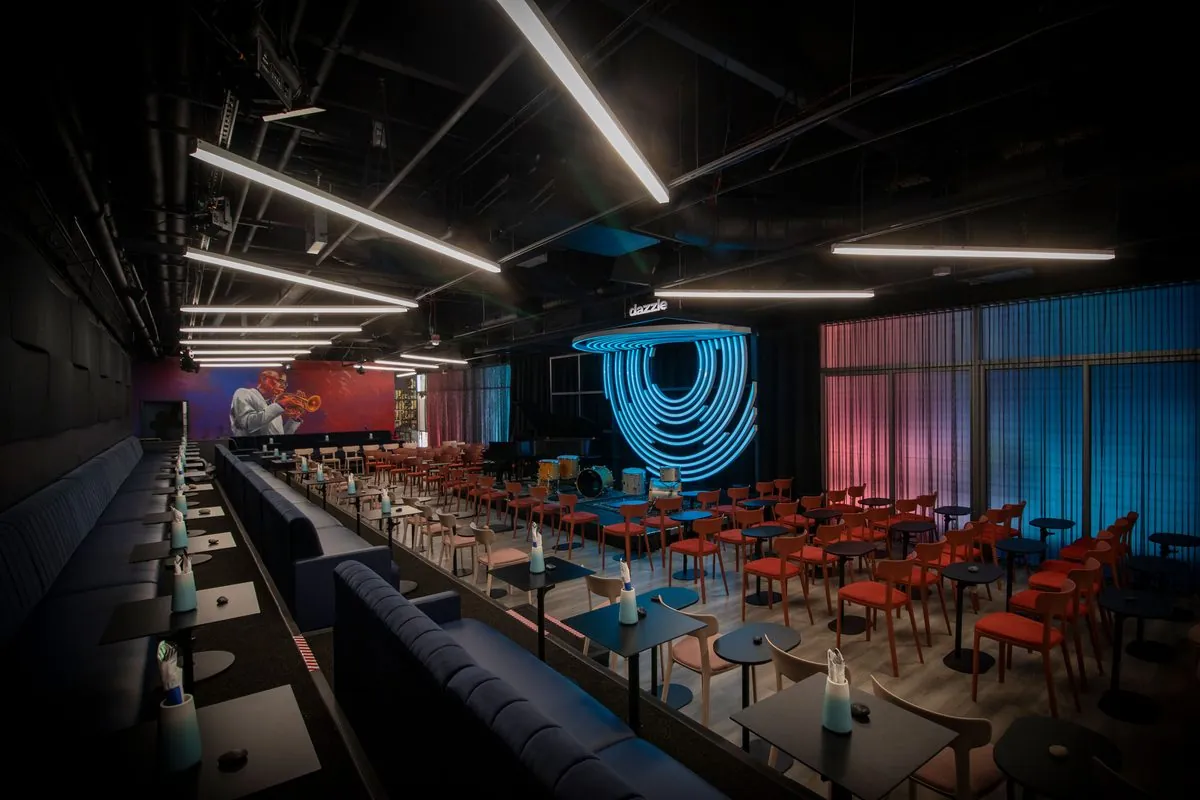
The only Colorado venue listed in DownBeat Magazine's Top Jazz Venues, three years running. At 29 years old, Dazzle hosts live music seven nights a week across jazz, blues, R&B, and Latin. The main listening room is a ticketed, serious-listening space; the bar and Pec Lounge are walk-in friendly. Full kitchen, happy hour, Sunday Brunch, and a Kids' Saturday Matinee round out a venue that proves Colorado's music scene goes far beyond rock and EDM.
Swallow Hill Music. 300 capacity
A folk and acoustic institution. Swallow Hill doesn't just host concerts—it runs music education programs and serves as a community hub. It's the venue that keeps Denver's folk and Americana roots alive.
Mountain Venues: Where Altitude Meets Attitude
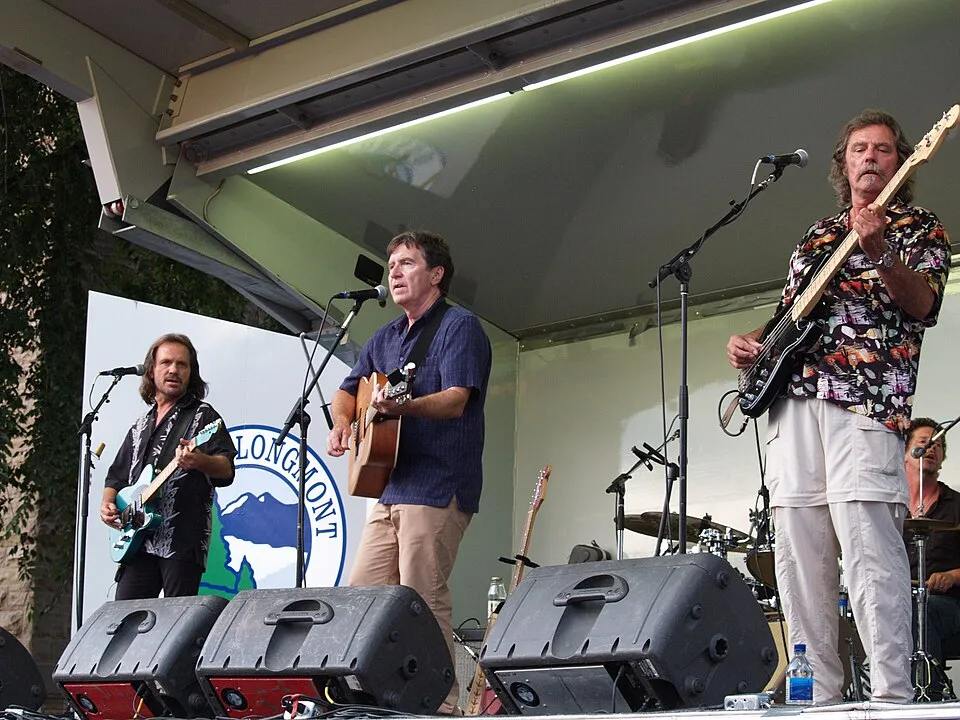
This is where Colorado's concert scene separates itself from every other state. No other region in America has top-tier music venues at elevation, surrounded by the kind of natural beauty that makes every show feel like a destination experience.
Mishawaka Amphitheatre, Bellvue (Poudre Canyon)
Capacity: 1,000
The Mish sits on the banks of the Cache la Poudre River, about 40 minutes up the canyon from Fort Collins. The venue is carved into a riverside clearing surrounded by towering canyon walls. The sound of the river provides a constant, natural undertone to every performance. Summer nights here—warm air, cold river water on your toes, live music echoing off canyon rock—are what Colorado's music scene is really about. It's small, intimate, and almost impossibly beautiful. Locals guard it jealously.
Related reading: What Makes a Chauffeur Different from a Driver?
Dillon Amphitheater, Dillon (Summit County)
Capacity: 2,600
Perched at 9,017 feet on the shores of Dillon Reservoir, this is one of the highest concert venues in the country. The backdrop is a panorama of the Gore Range and the Continental Divide. The free summer concert series draws both locals and visitors staying in nearby Breckenridge and Keystone. At this elevation, the stars after a show are wide-open.
Gerald R. Ford Amphitheater, Vail
Capacity: 2,500
Vail's top outdoor venue hosts the Bravo! Vail Music Festival and a summer-long lineup of concerts, dance performances, and cultural events. The setting is pure mountain luxury—manicured grounds, stunning views, and a crowd that ranges from ski-town locals to second-home owners. The Ford is proof that a ski town can sustain a top-tier arts scene year-round.
Belly Up Aspen — Aspen
Capacity: 450
In a town known for exclusivity, the Belly Up democratizes the music experience. Global headliners play a 450-seat room, creating the kind of proximity that's impossible in larger venues. The acoustics are pristine, and the vibe is upscale-casual—ski boots optional but not uncommon. Seeing a Grammy winner from 15 feet away in a room that smells like craft beer and mountain air is a uniquely Colorado experience.
Chautauqua Auditorium — Boulder
Capacity: 1,300
A 19th-century wooden hall set beneath Boulder's iconic Flatirons. The rustic acoustics are warm and natural, and the setting.a historic park with mountain views in every direction—gives every performance a timeless quality. The Chautauqua has been hosting cultural events since 1898, making it one of the oldest continuously operating venues in the state.
Telluride Town Park Stage — Telluride
Capacity: Varies (festival seating)
Telluride is synonymous with festivals. Bluegrass, Blues & Brews, Jazz, Film. The Town Park Stage, framed by 13,000-foot peaks on three sides, provides what might be the most dramatic natural backdrop of any festival venue in America. Telluride's festivals aren't just concerts—they're pilgrimages.
Boulder Theater, Boulder
Capacity: 850
A beautifully restored Art Deco venue in downtown Boulder that hosts everything from indie rock to comedy to film screenings. The Boulder Theater punches well above its weight, consistently attracting national touring acts to a mid-size room with genuine character.
Fox Theatre — Boulder
Capacity: 500
A compact, high-energy room on the Hill near CU Boulder's campus. The Fox is where college-town energy meets professional bookings, resulting in some of the most unpredictable and exciting shows in the state.
What Makes Colorado's Scene Unique
Other states have great venues. Nashville has the Ryman. Austin has Stubbs and ACL Live. New York has Madison Square Garden and Brooklyn Steel. So what makes Colorado different?
The Altitude Advantage
Colorado's venues sit at elevations ranging from 5,280 feet (Denver) to over 9,000 feet (Dillon). The thinner air creates a physiological effect that many concertgoers describe as feeling "more alive", heightened senses, quicker emotional responses, a slight light-headedness that pairs surprisingly well with live music. Artists regularly comment on how the altitude affects their performance, Ringo Starr famously recalled needing oxygen canisters at Red Rocks.
The Outdoor Culture
Coloradans don't just tolerate outdoor concerts—they live for them. The state averages 300 days of sunshine per year. Summer concert season (May through October) is treated as a cultural institution, and venues from Dillon to Mishawaka use natural settings that indoor venues can't compete with. Going to a show in Colorado often means hiking, tailgating, or rafting earlier in the day—live music is woven into an active outdoor lifestyle rather than isolated from it.
Related reading: What to Do : Beyond the Slopes and the Stage
The Craft Beer Ecosystem
Colorado has over 400 craft breweries, and the connection between the brewery scene and the music scene is symbiotic. Venues partner with local breweries for exclusive pours. Breweries host live music on their patios. The culture of "grab a local IPA and catch a show" is fundamental to the Colorado concert experience in a way that no other state has quite replicated.
The Artist Draw
Musicians want to play Colorado. The combination of Red Rocks' legendary status, the state's outdoor-recreation culture, and one of the most enthusiastic concert-going populations in America means that Colorado consistently attracts more touring acts per capita than states with much larger populations. SeatPick's 2024–2025 data ranked Colorado fifth in the nation for concertgoers, with residents searching for concert tickets 1,442 times per 100,000 people, higher than New York, California, or Florida.
Homegrown Talent
Colorado doesn't just attract musicians—it produces them. OneRepublic, The Lumineers, Nathaniel Rateliff & The Night Sweats, The Fray, Big Head Todd and the Monsters, DeVotchKa, and Earth, Wind & Fire all have Colorado roots. The state's music scene has a self-sustaining quality: local acts grow up playing small Denver venues, graduate to Red Rocks, and become ambassadors for the scene that raised them.
How Colorado Stacks Up
According to SeatPick's 2024–2025 national rankings, the top states for concertgoers are:
| Rank | State | Score | Concerts | Venue Capacity (% of Population) |
|---|---|---|---|---|
| 1 | Tennessee | 75.31 | 50 | 17% |
| 2 | Nevada | 72.86 | 114 | 66% |
| 3 | Louisiana | 67.58 | 21 | 9% |
| 4 | Montana | 63.49 | 6 | 1% |
| 5 | Colorado | 61.92 | 34 | 13% |
Tennessee has Nashville. Nevada has Las Vegas. Louisiana has New Orleans. Each owes its ranking to a single dominant city.
Colorado's ranking is different. It's driven by a state-wide ecosystem—Denver's urban venues, mountain amphitheatres, festival culture, and an audience that doesn't just attend concerts but organizes their lives around them. No other state offers top-tier live music from a 200-seat jazz club at 5,280 feet to an open-air amphitheatre at 9,017 feet, all within a few hours' drive.
Getting to the Show: Part of the Experience
about Colorado's concert scene that nobody mentions in the rankings: the journey to many of these venues is as memorable as the show itself.
A drive to Mishawaka follows the Poudre River through a stunning canyon. The road to Red Rocks winds through geological formations that glow in the setting sun. The approach to Telluride crosses mountain passes with views that stop traffic.
This is exactly why Arion, LLC exists. When the drive to the venue is part of the concert experience,and when the drive home after a mountain show involves dark, winding roads and post-concert exhaustion, having a professional chauffeur isn't a luxury. It's how you experience Colorado's concert scene the way it was meant to be experienced.
Related reading: What to Expect When Booking with Arion
Your Brain on Live Music: The Chemical Cocktail
When you attend a live concert, your brain doesn't just process sound. It launches a full-scale neurochemical event involving at least four major systems that are, under normal circumstances, associated with survival, reproduction, and social bonding.
Dopamine: The Pleasure Molecule
Dopamine—the neurotransmitter associated with pleasure, motivation, and reward—surges when you listen to music you enjoy. A 2019 study published in the Proceedings of the National Academy of Sciences confirmed that the dopamine released during music listening directly causes the associated pleasure, rather than accompanying it. This was validated by an earlier study from 1980 in Physiological Psychology—which showed that the drug naloxone (used to treat opioid overdoses) actually blocked musical pleasure by inhibiting dopamine release.
In other words: your brain processes a great concert the same way it processes food, physical intimacy, and survival rewards. The same ancient reward circuitry that kept your ancestors alive is what lights up when the bass drops at Red Rocks.
Related reading: The Vehicle Is the Easy Part
Robert Zatorre, a neuroscientist at McGill University, explains the mechanism: "We have a reward system that has been there for 100 million years, not for music but for survival. The brain is very good at making predictions about what will happen. The brain likes to be able to get the correct predictions, and that generates a reward." But the brain also craves surprise—when a melody takes an unexpected turn, the dopamine response can intensify. The interplay between anticipation and surprise is what makes live performances, with their improvisation and crowd energy, more chemically rewarding than recorded music.
Oxytocin: The Bonding Hormone
Oxytocin, often called the "love hormone" or "bonding hormone".increases during live music experiences, particularly those involving group participation. Research published in Frontiers in Human Neuroscience found that salivary oxytocin levels rose after singing activities, with participants reporting heightened feelings of well-being and social connection.
A full 2020 review in PMC detailed how oxytocin's effects mirror many of music's documented influences on human behavior: increased trust, reduced social vulnerability, enhanced empathy, and strengthened cooperative bonds. The researchers argued that music may have evolved specifically to use the pre-existing oxytocinergic system—essentially piggybacking on our brain's bonding chemistry to create social cohesion.
The implications are profound: when you feel inexplicably connected to the 10,000 strangers around you at a concert, that feeling is biochemical. Your body is literally producing the same hormone that bonds parents to children and partners to each other.
Cortisol Reduction: The Stress Eraser
If dopamine is the accelerator and oxytocin is the connector, cortisol reduction is the relief valve. A 2018 review in Progress in Brain Research analyzed 44 studies on music and stress, concluding that music listening—across all genres—reduces cortisol levels, the primary stress hormone.
This effect is amplified in live settings. The combination of musical stimulation, social connection, and environmental novelty creates a state that researchers describe as the opposite of chronic stress: fully absorbed attention without threat. Your brain shifts from its default mode network (the loop of self-referential worry and rumination) into a state of engaged flow.
As Dr. Danielle Kelvas, Chief Medical Advisor at Sleepline, summarized: "Music has been found to have a range of positive effects on mental health, including reducing stress, improving mood, and providing a sense of connection with others. Music can also help to build resilience and provide a sense of control in challenging situations."
The Full Chemical Picture
The neurochemical cascade extends further. Serotonin increases during music listening. Adrenaline surges during high-energy moments. Even immunoglobulins, antibodies involved in immune function, increase after group singing and drumming. A landmark 2013 study by Chanda and Levitin in Trends in Cognitive Sciences synthesized 400 scientific papers and found that music influences health through virtually every major brain chemical system—making live music one of the most detailed neurochemical interventions available to humans.
Collective Effervescence: Why Concerts Feel Sacred
Beyond brain chemistry, something happens at live concerts that scientists have only recently begun to study: a psychological phenomenon called collective effervescence.
The term, borrowed from sociologist Émile Durkheim's work on religious rituals, describes the sense of connection and transcendence that occurs when a large group of people shares an intense emotional experience. A groundbreaking 2024 study published in Personality and Social Psychology Bulletin—"Let the Music Play: Live Music Fosters Collective Effervescence and Leads to Lasting Positive Outcomes".examined this phenomenon across four studies with 789 participants and found something remarkable:
Collective effervescence at live music events uniquely predicted increased meaning in life and continued happiness one week after the event.
Related reading: What Makes a Chauffeur Different from a Driver?
Not during the event. A week later.
The researchers defined collective effervescence (CE) as two simultaneous feelings: "(a) a sense of connection to the other people present and (b) a perception that something special or sacred is occurring." When these two conditions align—and they align powerfully at live concerts—the psychological benefits extend far beyond the encore.
The study also found that three specific elements of the concert experience amplified collective effervescence:
- Parasocial bonds with the artist — Feeling a personal connection to the performer (even a one-sided one) increased the sense that something special was happening.
- Lyrical immersion — Being deeply absorbed in the music's words and meaning created a shared emotional space with the rest of the audience.
- Attending with friends — Social connection before and during the event heightened the feeling of collective transcendence.
As the PsyPost summary noted: "Those moments of shared connection don't just feel good in the moment—they can leave a lasting imprint on happiness and meaning in life."
This is what separates a live concert from a Spotify playlist. It is about theshared experience of being moved by music together,and the lasting psychological residue of that communion.
Physiological Synchrony: When Hearts Beat Together
One of the most striking discoveries in recent concert research involves physiological synchrony—the phenomenon where audience members' bodies literally synchronize during live performances.
A study published in Scientific Reports found that during live performances of works by Brahms, Beethoven, and Brett Dean, audience members' breathing rates, skin conductivity, and heart rates began to align. As researcher Wolfgang Tschacher observed: "Concert music moves audiences bodily. Music reaches the minds… and their bodies."
This isn't a metaphor. When you feel "in sync" with a concert crowd, your body is measurably, physiologically aligned with the bodies around you. And the research found that this synchrony was associated with decreased negative emotions and increased positive ones. When we listen together, our bodies come into rhythm with one another,and we feel better as a result.
Related reading: What to Do : Beyond the Slopes and the Stage
A study by Dana Swarbrick found that audience members who attended a live concert reported stronger feelings of belonging than those who watched the same performance via livestream. Sitting together, focusing on the same musical experience, fostered a subconscious sense of unity that streaming could not replicate.
Why Outdoor Venues Amplify Everything
If live music is powerful, live music in an outdoor setting is extraordinarily powerful. And the reasons go beyond "nice views."
Sound Physics Change Outdoors
In enclosed venues, sound waves bounce off walls, ceilings, and floors, creating complex reflection patterns that can muddy audio quality. Outdoors, these constraints disappear. Bass frequencies, which need space to fully develop their long wavelengths, can finally breathe. The physical sensation of bass at an outdoor show—the chest-thumping, ground-vibrating impact—is bass frequencies reaching their full potential for the first time. High frequencies remain crisp over longer distances without a ceiling to absorb them. The result is sound that feels simultaneously massive and clear.
Nature Engages Your Full Sensory System
The psychology of environmental context is crucial to understanding concert experiences. Research on context-dependent encoding shows that memories are stored more vividly when multiple senses participate in their creation.
Related reading: What to Expect When Booking with Arion
At an outdoor venue, you're not just hearing music. You're feeling the temperature shift as the sun sets. You're smelling pine resin and warm stone. You're seeing the sky transition through sunset colors while the music plays. You're feeling wind on your skin and the vibration of ancient rock beneath your feet.
This multi-sensory encoding creates what neuroscientists call "stickier" memories—experiences that are stored more deeply and recalled more vividly because the brain created a richer file format. This explains why outdoor concert memories often feel more vivid than indoor ones, even years later.
Attention Restoration
Attention Restoration Theory posits that natural environments restore our directed attention, which modern life constantly depletes. Outdoor concerts provide what researchers call "fascination"—stimulation that captures attention without hassle. The combination of nature and live music creates a dual restoration effect: the environment quiets the mind's chatter while music fills the newly opened space with emotional content. This explains why concertgoers at outdoor venues frequently describe feeling "renewed" afterward.
Memory Formation: Why Concert Memories Last Forever
"Music has the ability to influence a part of your brain called the hippocampus, which is essential for turning experiences into memories," explained Stephanie Leal, a UCLA professor of integrative biology and physiology. Her 2025 research, published in the Journal of Neuroscience—showed that music heard immediately after an experience can alter what we remember,and how vividly we remember it.
The connection between music and memory is bidirectional:
Music enhances memory formation. Emotional music we hear during specific life periods becomes strongly linked to autobiographical memory. A song heard at a formative moment.a first concert, a transformative night with friends, a milestone celebration—gets encoded alongside the emotions of that moment. When you hear it years later, the full emotional context floods back: the faces, the temperature, the feeling.
Related reading: Best Bars Near Red Rocks (Before & After Concerts)
Concerts create multi-layered memory encoding. When you're at a concert, your brain is recording motor memory (from dancing), spatial memory (the venue layout), social memory (who you were with), olfactory memory (the smells of food, night air, crowd), and emotional memory (the highs and lows of the performance). This redundant encoding creates memories that are resistant to decay.
Research on music and emotion reviewed in BMC Neuroscience confirmed that emotional arousal during music listening enhances memory encoding. Positive emotions and high arousal levels associated with specific events act as memory amplifiers—strengthening the associations between memories due to the intensity of the experience.
This is the neurological explanation for why people can recall, in vivid detail, concerts they attended 20 or 30 years ago. The experience wasn't just heard—it was embodied. The music became literally memorable because the entire nervous system participated in experiencing it.
How the Journey Shapes the Experience
Here's the finding that most articles about live music psychology overlook: the experience doesn't start when the music starts. It starts the moment you begin the journey to the venue.
Research on anticipatory pleasure shows that dopamine levels begin rising not at the moment of reward, but during the anticipation of reward. The drive to the venue, the approach to the entrance, the first glimpse of the stage—each step in the journey builds the neurochemical foundation that makes the concert itself more impactful.
This has practical implications. If the journey to a concert is stressful—fighting traffic, circling for parking, rushing to the entrance—the anticipatory pleasure is replaced by cortisol. You arrive at the show in a state of stress rather than anticipation, and the concert has to work harder to overcome that deficit.
Related reading: The Etiquette of Being Driven: A Passenger's Guide
Conversely, if the journey is itself pleasurable—a scenic drive through mountains, a comfortable vehicle, the freedom to focus on the approaching experience rather than logistics—the anticipatory dopamine builds naturally. By the time the music starts, you're already neurochemically primed for an extraordinary experience.
This is the science behind what luxury transportation companies like Arion, LLC understand intuitively: how you get to the concert is part of the concert. The journey isn't a logistical detail to be endured. It's the first movement of the symphony.
The Evolutionary Mystery: Why Music Moves Us at All
Patrick Whelan, a Harvard Medical School lecturer and instructor of "Music and the Mind," offers an evolutionary perspective. The earliest mammals, likely nocturnal, depended on hearing as a primary survival sense—hyperfocused on the acoustic cues of approaching predators and potential mates.
Modern concerts, Whelan suggests, tap into this adaptation. In a performance venue, "there's an very good complex sound signature all around you. The brain has to sift through all the ambient noise. It's a much more primitive form of listening."
The goosebumps during a powerful musical moment, called "frisson", may originate from early danger-alert systems. Goosebumps were originally a preparatory reaction to physical threats. In a concert's safe environment, this mechanism gets "hijacked" into pleasurable experience—a sense of "safe danger" the brain processes as thrilling.
Related reading: How Arion Trains Its Chauffeurs — And Why It Matters to You
At outdoor venues like Red Rocks—where ancient stone, open sky, and primal sound converge—this evolutionary connection feels strongest. You're engaging in one of humanity's oldest activities: gathering together to make noise under an open sky.
What This Means for You
The science is clear: live music isn't a luxury. It's one of the most powerful tools available for improving mental health, building social bonds, creating lasting memories, and experiencing the kind of transcendence that used to require religious ritual.
The research suggests concrete ways to maximize these benefits:
Related reading: Best Music Festivals in Colorado (2026 Guide)
- See artists you feel connected to. Parasocial bonds amplify collective effervescence and its lasting benefits.
- Go with friends. Social connection before and during the event enhances the experience.
- Choose outdoor venues when possible. Multi-sensory encoding creates stronger, longer-lasting memories.
- Immerse yourself in the lyrics. Lyrical absorption deepens the collective experience.
- Make the journey part of the experience. Anticipatory pleasure builds the neurochemical foundation for a more powerful experience.
- Prioritize comfort and relaxation. Stress and anxiety compete with the neurochemical benefits of live music. Remove logistical friction wherever possible.