Quick Answer: If you've spent any time on social media, talked to anyone who's been to Colorado, or simply searched "best concert venues," you've heard the...
If you've spent any time on social media, talked to anyone who's been to Colorado, or searched "best concert venues," you've heard the hype. Red Rocks Amphitheatre is consistently ranked the #1 outdoor concert venue in the world—and has been for so long that Pollstar literally renamed the award after it so other venues could have a chance.
But is it actually worth the trip? The ticket prices? The altitude? The stairs?
We talked to dozens of concertgoers, read hundreds of reviews, and—full disclosure—we've lost count of how many shows we've attended there ourselves. Here's the unfiltered truth.
What Makes Red Rocks So Special
The Setting Is Literally Prehistoric
Red Rocks isn't a venue that was built. It was discovered.
The amphitheatre sits between two 300-foot sandstone monoliths—Creation Rock and Ship Rock—that were formed over 250 million years ago, during the late Paleozoic era. Dinosaur tracks have been found nearby, and fragments of a 40-foot Plesiosaur (a prehistoric sea creature) were discovered at the site.
You're not walking into a stadium. You're stepping into a geological wonder that happens to have 9,525 seats and the most perfect natural acoustics on the planet.
Related reading: Red Rocks Pickup and Drop-Off Guide
The Acoustics Are Unmatched
This is the detail that separates Red Rocks from every other "great venue" you've been to.
The two massive rock formations act as a natural sound funnel, directing audio waves directly toward the audience with virtually no diffusion. The result? Crystal-clear sound without the over-amplified harshness of indoor arenas. You can hear individual instruments, the shimmer of a cymbal, the texture of a voice, in a way that's impossible in a traditional venue.
Musicians notice it too. Artists routinely describe playing Red Rocks as the peak of their career. The natural reverberation means less reliance on electronic amplification, creating a warmer, more organic sound that's closer to how music was meant to be heard.
The View Changes Everything
As the sun sets during an evening show, here's what unfolds:
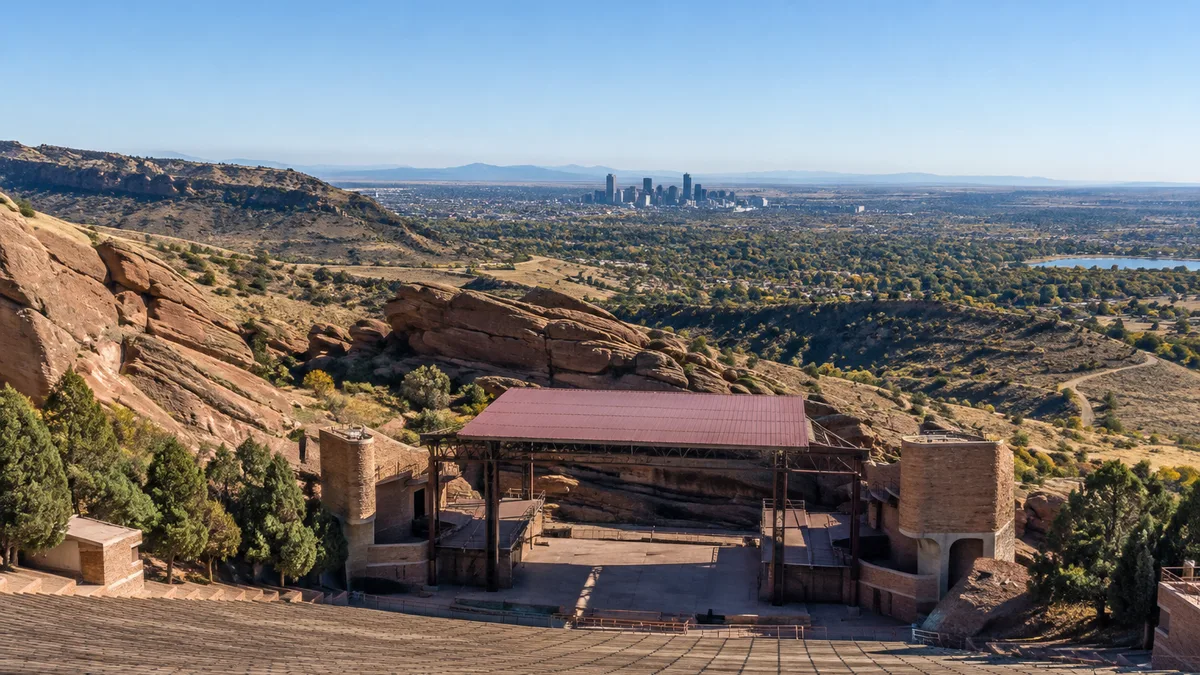
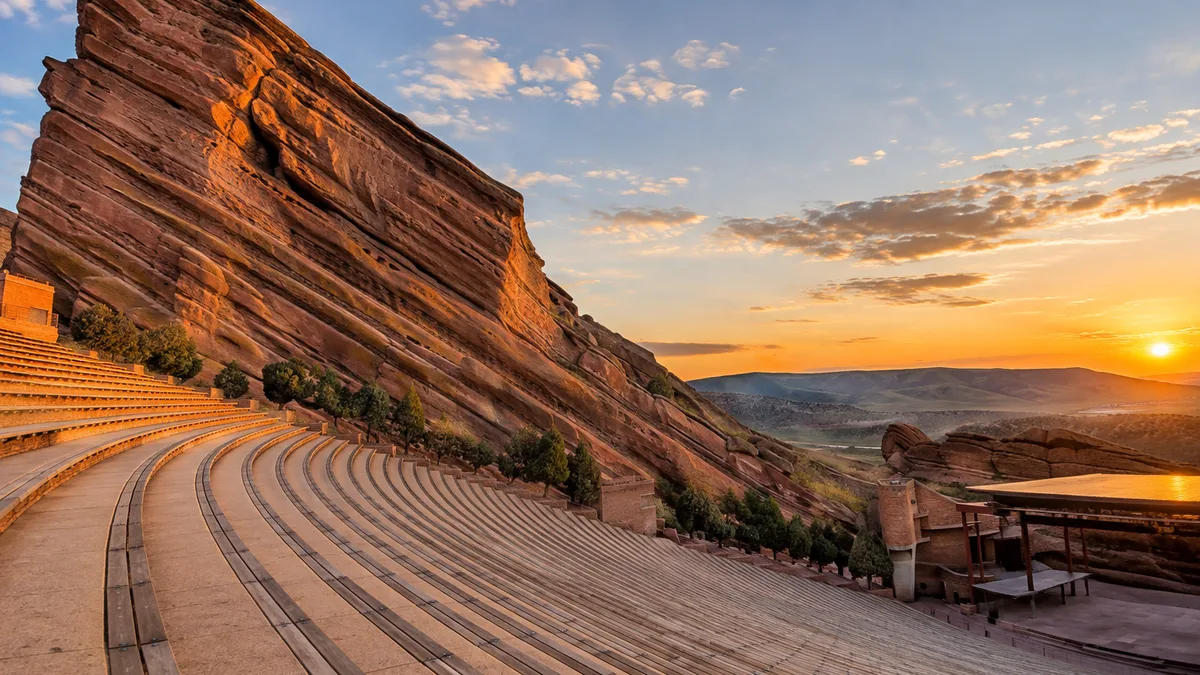
The massive red sandstone walls shift from deep crimson to glowing amber. The Denver skyline appears in the distance, its lights flickering to life against the darkening plains. Above you, the Colorado sky transitions through every shade of pink, orange, and purple before opening up to a canopy of stars that feels impossibly close at 6,450 feet.
And all of this is happening while your favorite artist performs.
It's not just a concert. It's a multisensory experience where nature and music merge into something that can't be replicated.
The Honest Downsides (And How to Handle Them)
We'd be doing you a disservice if we didn't address the real challenges. Red Rocks is impressive, but it's not a luxury arena with climate control and escalators.
The Stairs Are No Joke
There are 70 rows of bleacher-style seating, and the difference in elevation from the stage to the top row is roughly 100 feet. Getting to your seat—especially if you're parked in the Lower North or Lower South lots—involves a significant uphill climb.
The fix: Wear comfortable, closed-toe shoes (heels are a genuine safety hazard on those steps). Arrive early so you can take your time. And if you're driving, aim for the Upper North Lot, which is closest to the top entrance and requires the least climbing.
Related reading: What to Bring to Red Rocks (And What You Can't)
The Weather Is Unpredictable
At 6,450 feet elevation in the Colorado foothills, you can experience sunshine, wind, rain, and near-freezing temperatures—all in the same evening. We've seen hail in June and snow in April. Shows proceed in virtually all weather.
The fix: Dress in layers, always bring a poncho (umbrellas are prohibited), and check the forecast—but prepare for it to be wrong. The altitude also intensifies sun exposure, so sunscreen is non-negotiable even for evening shows.
The Altitude Is Real
If you're visiting from sea level, you'll feel the 6,450-foot elevation. Climbing stairs will leave you more winded than expected. Alcohol hits harder. Dehydration creeps up faster.
The fix: Drink significantly more water than you think you need. Take the stairs slowly. Go easy on the drinks, especially your first time. Hydration packs (CamelBaks, 2L or smaller) are allowed.
Parking and Traffic Can Be Chaotic
After the show, 9,525 people all try to leave through a handful of mountain-road exits at the same time. It's not unusual for the post-show parking lot exit to take 30–45 minutes.
The fix: Either leave during the encore (you'll beat the rush but miss the finale) or have someone else handle the driving entirely. Private car services and shuttles drop off and pick up at the Top Circle Lot.the most convenient access point—bypassing the general parking chaos entirely.
What Real Visitors Say

The reviews speak for themselves:
"I've seen over 100 concerts in different venues throughout the country. Red Rocks by far offers the best acoustics, atmosphere and views. Everyone needs to experience Red Rocks."
"There are no words to properly describe the beauty and uniqueness of this landmark. It's an absolute MUST."
Related reading: Best Bars Near Red Rocks (Before & After Concerts)
"Even if there's no event going on, it's totally worth a visit. The acoustics are fantastic. Best part? It's free on non-event days!"
"I visit Denver every two years. Each time I visit I try to get to Red Rocks Park. The view is awesome and the people are welcoming."
"When the dusk of evening sets in, it is purely magical and it took my breath away looking at the richness of the red rocks colour change as the sun fell."
The consistent themes across thousands of reviews: the acoustics, the views, the atmosphere. And nearly every negative review traces back to logistical issues, parking, stairs, weather, all of which are solvable with a little preparation.
Who Will Love Red Rocks Most
Music lovers of any genre. Red Rocks hosts everything from EDM to country, classical to comedy. The venue raises every genre.
Photographers and visual people. Between the rock formations, the sunset, and the Denver skyline, every angle is frame-worthy.
Couples. There's a reason Red Rocks shows are a top date-night experience in Colorado. Sharing a blanket as the sun sets between the monoliths is romantic.
Related reading: Best Hotels Near Red Rocks: Luxury, Mid-Range, Budget &
Bucket-list travelers. If you're visiting Colorado and can align your trip with a show, it should be non-negotiable. This is one of those experiences that lives up to, and exceeds, the hype.
People who love outdoor experiences. If you'd rather be under the stars than under a roof, Red Rocks is your venue.
Who Might Want to Think Twice
Anyone with severe mobility issues. While ADA seating is available at rows 1 and 70, the venue involves significant stair-climbing and uneven terrain. Plan ahead and use accessible parking and shuttle options.
People who are very sensitive to altitude. If you've had altitude sickness before, take precautions. Arrive in Denver a day early to acclimate if possible.
Those expecting a luxury arena experience. Red Rocks is bleacher seating, outdoor elements, and porta-potties alongside permanent restrooms. It's rugged beauty, not polished luxury. (Though your ride there can be.)
The Verdict: Is Red Rocks Worth It?
Absolutely, unequivocally, yes.
Red Rocks doesn't just meet expectations—it transcends them. The combination of natural acoustics, prehistoric geology, panoramic views, and that indefinable Colorado energy creates something no indoor arena, festival stage, or rooftop bar can touch.
Is it perfect? No. The stairs are brutal, the weather is unpredictable, and the parking situation is a genuine challenge. But every one of those imperfections is either manageable or, in the case of the weather, part of what makes the experience feel so alive.
Related reading: Colorado Concert Weather: What to Expect Month by Month
The real question isn't whether Red Rocks is worth it. It's how to make the most of it. And the answer starts before you even get to the venue.
Make It Simple
The best Red Rocks nights start with zero stress. Instead of navigating mountain roads, hunting for parking in the dark, and sitting in a 45-minute exit line, imagine this: a professional chauffeur picks you up at your door, drops you at the VIP entrance, and is waiting for you when the lights come up.
Arion's luxury car service specializes in Red Rocks transportation—door-to-door from anywhere in the Denver area. Because the best concert of your life deserves more than a rideshare. →
For the complete picture, see our The Guide to Colorado Concerts (2026 Edition).
Related reading: Concert Date Night Itinerary: Red Rocks Edition
Your Red Rocks night, handled.
Planning something important? Arion provides luxury transportation and selected travel experiences built around care, discretion, and the belief that every guest should feel considered from the first conversation to the final drop-off.
Frequently Asked Questions
What Makes Red Rocks So Special?
Red Rocks isn't a venue that was built. The amphitheatre sits between two 300-foot sandstone monoliths—Creation Rock and Ship Rock—that were formed over 250 million years ago, during the late Paleozoic era. Dinosaur tracks have been found nearby, and fragments of a 40-foot Plesiosaur (a prehistoric sea creature) were discovered at the site.
What Real Visitors Say?
The reviews speak for themselves: "I've seen over 100 concerts in different venues throughout the country. Red Rocks by far offers the best acoustics, atmosphere and views. Everyone needs to experience Red Rocks." "There are no words to properly describe the beauty and uniqueness of this landmark.
What is the verdict — is Red Rocks worth it?
Absolutely, unequivocally, yes. Red Rocks doesn't just meet expectations—it transcends them. The combination of natural acoustics, prehistoric geology, panoramic views, and that indefinable Colorado energy creates something no indoor arena, festival stage, or rooftop bar can touch.
How does concert pickup work after the show?
Your chauffeur is parked on site before the venue's 8:30 p.m. vehicle-entry cutoff and waits there through the show, then texts you the exact location as the encore ends. You walk to a waiting vehicle instead of queuing in a lot or waiting on surge pricing.
The Drive Up: Where the Anticipation Builds
It begins in the car.
the approach to Red Rocks is its own kind of overture. The highway gives way to two-lane roads. Strip malls dissolve into sandstone. The terrain tilts upward, and the flat expanse of the Great Plains falls away behind you.
If you're in the back seat of a chauffeured vehicle, this is the moment you lean forward. Through the windshield, the rock formations start to emerge—massive, rust-colored slabs jutting from the earth at impossible angles, glowing in the late-afternoon light like they've been set on fire from within.
Related reading: Best Bars Near Red Rocks (Before & After Concerts)
You catch your first glimpse of the monoliths. Those monoliths. The ones you've seen in a thousand concert videos. Creation Rock and Ship Rock—each over 300 feet tall, taller than Niagara Falls, older than the dinosaurs that left their footprints in the stone nearby. They don't look real. They look like something a film studio built for a scene they couldn't quite believe would work on screen.
Your pulse picks up. This is really happening.
Arrival: Stepping Into the Prehistoric
The parking lots are buzzing. Tailgaters have claimed their spots with camp chairs, coolers, and Bluetooth speakers previewing tonight's setlist. The energy is somewhere between a music festival and a family reunion—friendly, excited, a little giddy.
But the real experience starts when you begin walking toward the entrance.
If you're coming from the lower lots, the path rises. The steps, carved from the same red stone that built this place, are steep, wide, and humbling. At 6,450 feet, your lungs notice the altitude immediately. Visitors from sea level sometimes describe feeling like they've run a mile after climbing two flights. As one first-timer put it: "I expected a walk and I'd heard there was a little bit of a hike up to the amphitheatre entrance. I did not expect stairs made for giants."
Related reading: Colorado Concert Weather: What to Expect Month by Month
But even the climb is part of it. With each step, the everyday world drops further away. The parking lot noise fades. The rock walls rise around you. The air smells different up here—cleaner, drier, with a mineral quality that's hard to place. Pine resin from the surrounding park mingles with the faint sweetness of sunscreen and the earthy warmth radiating off ancient sandstone.
You're not walking into a building. You're ascending into something.
The First Glimpse: When Time Stops

Everyone who's been to Red Rocks remembers this moment.
You crest the final rise, and the amphitheatre opens up in front of you—a vast, sweeping bowl carved between those two towering monoliths, with 70 rows of bench seating cascading down to a stage that seems impossibly far below. Beyond the stage, past the rock formations, the entire Front Range stretches into the distance, with Denver's skyline glittering faintly on the horizon.
The scale is staggering. The beauty is disorienting.
Related reading: Concert Date Night Itinerary: Red Rocks Edition
One concert blogger captured it perfectly: "You look down at the steps that lead you up to Red Rocks, everything melts away. You are alone for these seconds as you let the vibrations pulse through your body with each step. Looking down, not up, because you want to get to the top step first and then pick your head up and see what you have been waiting years for."
People stop in their tracks. Phones come out reflexively, but most visitors just... Stand there. Some get teary. It's that kind of place.
A TripAdvisor reviewer from Atlanta described arriving for the first time: "The elevation is quite high and walking from the parking lot uphill to the amphitheatre is not easy, but it's all worthwhile once you arrive at your seat. Once the sky was dark we could see the city lights and the red rocks were lit up with moving spotlights. It was magical!"
Finding Your Seat: The Geometry of Awe
Red Rocks seating is bleacher-style—long wooden benches on concrete steps, no assigned boundaries, just row numbers and a sense of shared space. The intimacy is surprising for a venue this large. Bodies press together. Strangers become seatmates. The bleachers vibrate faintly with the collective weight and movement of nearly 10,000 people.
Where you sit changes the experience:
Rows 1–20 put you close to the performers. You can see facial expressions, guitar fingering, the sweat on the drummer's forehead. The sound is direct and powerful—chest-thumping bass, vocals that cut through the air like a knife.
Related reading: Concert Packing List for a Red Rocks Trip
Rows 30–40 are the sweet spot for many regulars. The sound is beautifully balanced here—the natural acoustics of the rock walls have fully formed the mix, and you can take in both the stage and the Denver skyline emerging behind it. Close enough to feel the music, far enough to see the spectacle.
Rows 50–70 offer the panoramic experience. From here, you see the full sweep of the amphitheatre—the monoliths towering on either side, the crowd stretching below, the sky opening above. On a windy night, the sound may drift slightly, but the visual grandeur more than compensates.
Regardless of your row, there's one universal truth at Red Rocks: there are no bad seats. Every angle offers an unobstructed view of the stage, and the natural acoustics mean the sound quality doesn't degrade the way it does in a conventional arena. As longtime regular Bill K. From Minnesota put it: "The sound quality due to the natural acoustics, the seating spacing that allows for people to go in and out without stepping on you, and the laid-back vibe are all big pluses."
The Golden Hour: Nature's Opening Act
About an hour before the headliner takes the stage, something extraordinary begins.
The sun, which has been warming the red stone all day, starts its descent toward the Rocky Mountain ridgeline behind you. The light shifts, from bright white to warm gold to deep amber. The sandstone walls begin to glow, as if lit from within, cycling through shades of copper, rust, and crimson that no screen has ever faithfully captured.
The crowd collectively inhales.
Related reading: Denver Weekend Itinerary Built Around a Concert at Red Rocks
At this elevation, the sunset is both closer and more vivid than anything at sea level. The thinner atmosphere strips away the haze, leaving colors so saturated they look digitally enhanced. Pinks bleed into purples. Oranges flame into reds. The Denver skyline, 16 miles east, begins twinkling to life as if on cue.
Meanwhile, you can feel the temperature shift. The mountain air, which was warm in the sunshine, begins to cool. Layers come on. Strangers lean a little closer. The anticipation builds.
This is the part that makes Red Rocks a Red Rocks experience and not just a concert. Nature is the opening act, and it never disappoints.
The Music Begins: Where Sound Becomes Physical
The house lights drop.
9,525 people scream in unison—a wall of sound that ricochets off Creation Rock and Ship Rock and hits you in the chest.
Then: the first note.
Related reading: How Altitude Affects Your Concert Experience at Red Rocks
At Red Rocks, sound doesn't just travel to your ears. The two monoliths act as a natural sound funnel, directing audio waves toward the audience with almost no diffusion. The result is a clarity that's impossible in an indoor arena—instruments separate, vocals soar, and bass frequencies find room to fully develop their wavelengths in the open air. You don't just hear the music. You feel it in your ribs, your fingertips, the soles of your feet.
One reviewer described the acoustics this way: "The natural environment of the amphitheatre allows for the sound to resonate throughout the area, creating an almost magical atmosphere. The combination of the natural acoustics and the music creates a soundscape that is unique and memorable."
As The AU Review noted: "or a solo singer wistfully sending their voice flying through the funnel-like venue, Creation Rock and Ship Rock have honed a sound so pure and crystal that seeing a concert here is a singular experience."
And then there are the artists themselves. Musicians play differently here. They know this stage is special—many have dreamed of it their entire careers. String Cheese Incident's Keith Moseley described the sensation from the stage: "The energy gets funneled down from the crowd to the stage. You look up and everyone's looking down at you, framed by the giant rock monoliths."
That energy is cyclical. The crowd feeds the performer. The performer feeds it back. The rocks amplify everything. It spirals upward, and by the third or fourth song, you've entered a different state entirely—one where the boundary between audience and performer, between individual and collective, starts to dissolve.
How Genre Changes the Experience
Not all Red Rocks nights feel the same. The venue is a chameleon—it takes on the character of whatever's playing.
An EDM Night
The bass hits different at Red Rocks. With no ceiling to contain it, the low end rolls through the amphitheatre like thunder, vibrating the stone benches and your sternum simultaneously. Laser shows bounce off the rock walls, creating patterns that seem to emerge from the earth itself. The crowd, younger, more kinetic, turns the entire venue into a single pulsing organism. Glow sticks arc through the dark air like fireflies. The energy is primal, almost tribal.
As one EDM devotee wrote: "For EDM performances, Red Rocks takes on a mythical status. You look behind you up through this cavernous space or you look down into it and it is all one pulsing party machine."
Related reading: How to Plan the Perfect Concert Night in Denver
An Acoustic Night
Strip away the production, and Red Rocks reveals its truest gift. A single voice, an acoustic guitar—the rocks do the rest. Every note rings clear and true, carrying to the top row without amplification assistance. The crowd hushes. You can hear someone cough six rows away. The intimacy is startling for a 9,525-seat venue.
James Taylor reportedly declared "there was no better place in the universe to play a show than Red Rocks." On acoustic nights, you understand exactly why.
A Comedy Show
Comedians at Red Rocks face a unique challenge: their timing has to account for the natural reverb. But the payoff is enormous. Laughter at Red Rocks is a physical phenomenon—it cascades from the top rows down, bouncing between the monoliths, building on itself until the entire amphitheatre is shaking. Bill Burr filmed his comedy special here, and the venue's ability to transform from concert hall to comedy cathedral is part of what keeps performers coming back.
A Jam Band Night
This is where Red Rocks becomes almost spiritual. Bands like Widespread Panic, String Cheese Incident, and the Grateful Dead (who played legendary sets here in the late '70s and '80s) use the venue's acoustics to stretch songs into extended improvisations. The crowd sways together. The set has no rigid boundaries. Time becomes elastic. A three-hour show feels like forty-five minutes.
The Encore and After: How It Ends (and Doesn't)
The encore at Red Rocks is its own ritual.
The headliner exits. The crowd roars. The sound bounces between the walls for what feels like a full minute. Phones light up—thousands of small white rectangles floating in the dark, a modern constellation.
The artist returns. The final songs are always the biggest, the most emotional. Many performers save something special for Red Rocks—a debut, a deep cut, a cover that only makes sense in this setting. The crowd sings along, and the sound of 9,525 voices merging with the amplified music and the natural reverb of 300-million-year-old stone is something that bypasses your brain entirely and lands somewhere in your chest.
Related reading: Red Rocks Concert Schedule 2026: Full Lineup + Insider Tips
Then it's over.
The house lights come up. The spell breaks,but not entirely. People linger. They look around the amphitheatre one more time, trying to imprint the image. They hug strangers. They stand in silence at the railing, looking out at Denver's lights spread across the plains below.
The walk out is quieter than the walk in. The steep stairs that challenged you on the way up now carry you down gently. The cool mountain air feels different—thinner, but also fuller somehow. The parking lot exodus is famously slow, 9,525 people funneling through mountain roads, but even the wait feels different. The car is warm. The music is still ringing in your ears.
As one fan summarized: "You will never forget what it was like."
Why the Journey to Red Rocks Matters
Here's what most people don't consider: the experience of getting to Red Rocks is part of what makes the concert itself so powerful.
Research in psychology has shown that anticipation amplifies enjoyment—the journey primes your emotional state. The winding mountain drive, the first glimpse of the rocks, the climb up the ancient steps—each element builds the experience layer by layer, so that by the time the music starts, you're already in an raised emotional state.
This is why how you get there matters more than most people realize. Being dropped off at the top entrance in a comfortable vehicle—relaxed, hydrated, free from parking anxiety—means you arrive in the emotional state Red Rocks deserves. No white-knuckle mountain driving. No circling parking lots. No 30-minute uphill hike before the show even starts.
Related reading: Red Rocks: The Place That Was Never Supposed to Exist |
Arion's Red Rocks concert transportation was designed around exactly this understanding. Because the concert doesn't start when the band takes the stage. It starts the moment you begin the drive up.
