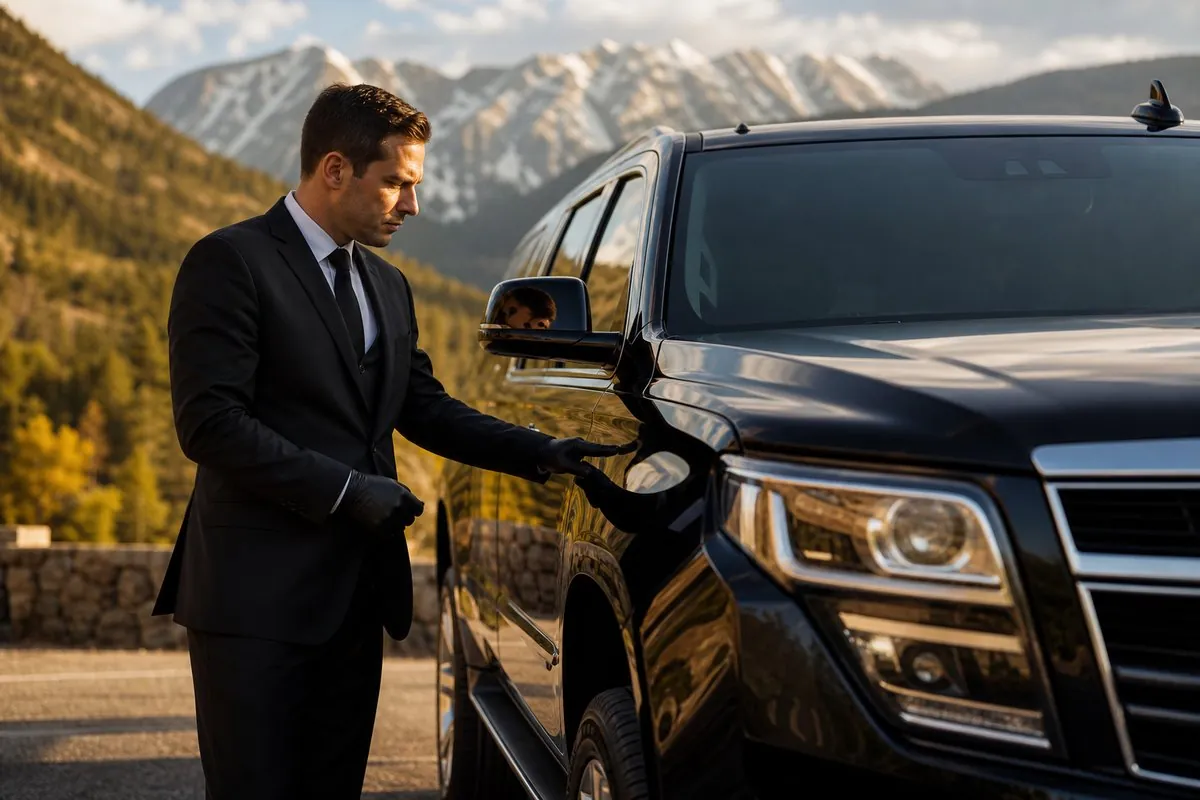
Quick Answer: Every Arion chauffeur completes defensive driving certification, Colorado mountain route training, vehicle staging protocols, and client hospitality coaching before their first trip. Ongoing evaluations and seasonal refreshers keep standards consistent year-round.
Who This Article Is For
- Corporate travel managers evaluating service quality and training standards
- Wedding planners vetting transportation vendors for high-stakes events
- Travelers who want to understand the training behind professional chauffeur service
- Business owners comparing car service providers in Colorado
- Anyone curious about what separates trained chauffeurs from app-based drivers
The Car Costs Money. The Driver Costs Trust.
A black Escalade is a black Escalade. You can rent one. You can buy one. The vehicle itself isn't the differentiator — the person operating it is. And the quality of that person's preparation determines whether a client's experience is forgettable or genuinely good.
At Arion, chauffeur training isn't a one-day orientation. It's a structured process that covers driving skill, route knowledge, client interaction, vehicle care, safety protocols, and the less obvious things, like knowing when to speak and when to be quiet.
Defensive Driving, Not Just a Certificate on a Wall
Every Arion chauffeur holds a current defensive driving certification. But the certification is the starting point, not the finish line.
Related reading: The Etiquette of Being Driven: A Passenger's Guide
Colorado driving is different from most states. You're not just dealing with urban traffic. In a single trip from DIA to Vail, you'll navigate:
Related reading: The Psychology of Live Music: Why Concerts Change You
- Highway speed merges on I-70—with semi-trucks carrying their own weather systems of spray and wind
- The Eisenhower Tunnel at 11,158 feet — where altitude affects engine performance and driver alertness
- Vail Pass in winter—where black ice forms on bridges before it appears on pavement
- Construction zones that shift weekly—sometimes with lane changes at 10,000 feet on a two-lane road
Our defensive driving training is Colorado-specific. Chauffeurs learn to read mountain weather, understand chain law compliance triggers, manage descent braking on sustained grades, and make real-time route decisions when conditions change mid-trip.
Route Knowledge, Not GPS Dependence
GPS gets you to an address. It doesn't tell you which DIA terminal entrance has the shortest walk for an arriving passenger. It doesn't know that the Red Rocks south lot fills first on Saturday headliners and the upper south lot is a better staging spot. It doesn't account for the fact that the I-70 eastbound backup starts at the Eisenhower Tunnel exit on Sunday afternoons, not at Georgetown like the traffic app suggests.
Our chauffeurs learn routes by driving them — repeatedly, in different conditions, at different times of day. They know:
- DIA terminal layouts — every airline's arrival area, cell phone lot timing, and the difference between Level 5 East and West pickup zones
- Red Rocks access — the four approach routes, where each one backs up, and which one to use based on show time and direction of travel
- Mountain resort drop-offs: Vail Village vs. Lionshead, Beaver Creek's gate protocol, Breckenridge's Main Street loading zones
- Denver venue specifics: Four Seasons porte-cochère, Brown Palace approach, Convention Center loading dock access
- Wedding venues—many Colorado wedding venues are on unpaved mountain roads with specific turnaround points for large vehicles
This knowledge doesn't come from a manual. It comes from miles driven and situations encountered.
Vehicle Staging, The 30 Minutes You Never See
Before every pickup, an Arion chauffeur spends roughly 30 minutes preparing the vehicle. Most clients never think about it. That's the point.
The staging checklist:
- Exterior wash or wipe-down (yes, even in winter, road salt gets cleaned)
- Interior vacuum and wipe — seats, console, floor mats, cup holders
- Temperature pre-set based on weather, the vehicle is the right temperature when you step in, not five minutes later
- Water bottles chilled and placed
- Phone chargers tested and positioned
- Music set to an appropriate low level (or off, depending on the client's known preferences)
- Route loaded with real-time traffic pulled — not just destination entered
Rideshare drivers pick up passengers in whatever state their personal car happens to be in. That gap between "whatever state" and "staged and ready" is 30 minutes of work that changes how the ride feels from the first second.
Client Interaction — Reading the Room at 65 mph
Hospitality training for chauffeurs is harder to quantify than driving skill, but it matters just as much.
Our training covers:
- Greeting protocol—professional, warm, not overly familiar. First-time clients get a name introduction and trip overview. Repeat clients get recognized without being made to feel surveilled.
- Reading energya corporate executive finishing a phone call needs quiet. A bachelorette group heading to dinner wants energy. A family arriving after a six-hour flight wants calm efficiency. The chauffeur adjusts.
- Communication timing — route updates are welcome. Personal questions are not. Traffic explanations are helpful. Running commentary on local landmarks is offered, not imposed.
- Problem management — when plans change (and they always do), the chauffeur communicates clearly and calmly. "We're rerouting due to an accident on I-25. Adding about 12 minutes." Not panic. Not silence. Information.
The best chauffeurs disappear into the background when that's what you need, and step forward when you need something handled. That toggle doesn't happen by accident — it's trained.
Safety Protocols Beyond the Obvious
Every transportation company talks about safety. Here's what ours actually covers:
- Medical emergency response—closest hospital knowledge for every common route, basic first aid, how to communicate with 911 while managing the vehicle and the passenger
- Severe weather protocol — when to pull over, when to keep moving, when to contact dispatch for route alternatives. Colorado weather can shift in minutes, a chauffeur needs to make the right call without hesitation.
- Vehicle failure procedures—tire blowout protocol on the highway, engine warning responses, how to safely stop on a mountain road shoulder vs. push to the next pulloff
- Client safety in unfamiliar environments—walking clients to doors in dimly lit areas, waiting until they're inside before departing, adjusting for venues with complicated access
It Doesn't End After Orientation
Training isn't a one-time event. Arion chauffeurs go through:
- Seasonal refreshers—winter driving protocols before the first snow, summer construction zone updates, festival season route changes
- Client feedback reviews—not just "rate your ride 1-5." Specific feedback is discussed and applied.
- Ride-alongs—periodic observation rides where operations reviews the chauffeur's full performance: driving, staging, client interaction, problem-solving
- New route familiarization—when a new venue, hotel, or event space opens, chauffeurs drive the route and learn the access before any client booking
Consistency requires maintenance. A chauffeur who was great six months ago but hasn't adapted to new construction patterns or venue changes isn't delivering the same quality.
What This Looks Like with Arion
What this looks like with Arion:
- Your chauffeur has driven your exact route before — multiple times, in similar conditions
- The vehicle was staged and inspected before you saw it
- Your driver knows DIA, Red Rocks, and every major Colorado venue by memory — not by app
- If conditions change, the response is calm, informed, and immediate
- Every interaction is trained, not improvised
Frequently Asked Questions
What areas does Arion serve in Colorado?
Arion serves the entire Denver metro, all Front Range cities, and every mountain resort town in Colorado. Long-distance transfers anywhere in the state are a specialty.
How are Arion chauffeurs screened before they drive?
Every chauffeur clears a criminal background check, an MVR review and drug testing, and carries the credentials Colorado requires of a commercial passenger carrier.
What does Arion's training cover beyond driving?
Route and venue knowledge for DIA, Red Rocks and the I-70 corridor, winter and traction-law operation, vehicle staging and inspection before pickup, and the service standards in the Driver Excellence Manual.
Are chauffeurs retrained after they start?
Yes. The SOP is reissued with acknowledgment on each revision, and recertification is tracked per driver rather than assumed.
Is Arion licensed and insured?
Arion operates under Colorado PUC authority and carries full commercial auto and general liability coverage on every vehicle, on every trip.
Keep Reading
 Experience
What Makes a Chauffeur Different from a Driver?
Training, anticipation, discretion, and hospitality — what separates a chauffeur from someone who drives.
The Vehicle Is the Easy Part
The vehicle is the stage. The service is the performance. What makes transportation actually feel like luxury.
Private Car Service vs Rideshare: What Colorado Travelers Should Know
An honest comparison of licensing, insurance, reliability, and when each option makes sense.